'Black Summers' Turns Detroit Summers Into Stories of Black Queer Joy
Editor Desiree Cooper discusses the new anthology's LGBTQ+ stories, Detroit roots and why summer remains a powerful site of memory and belonging
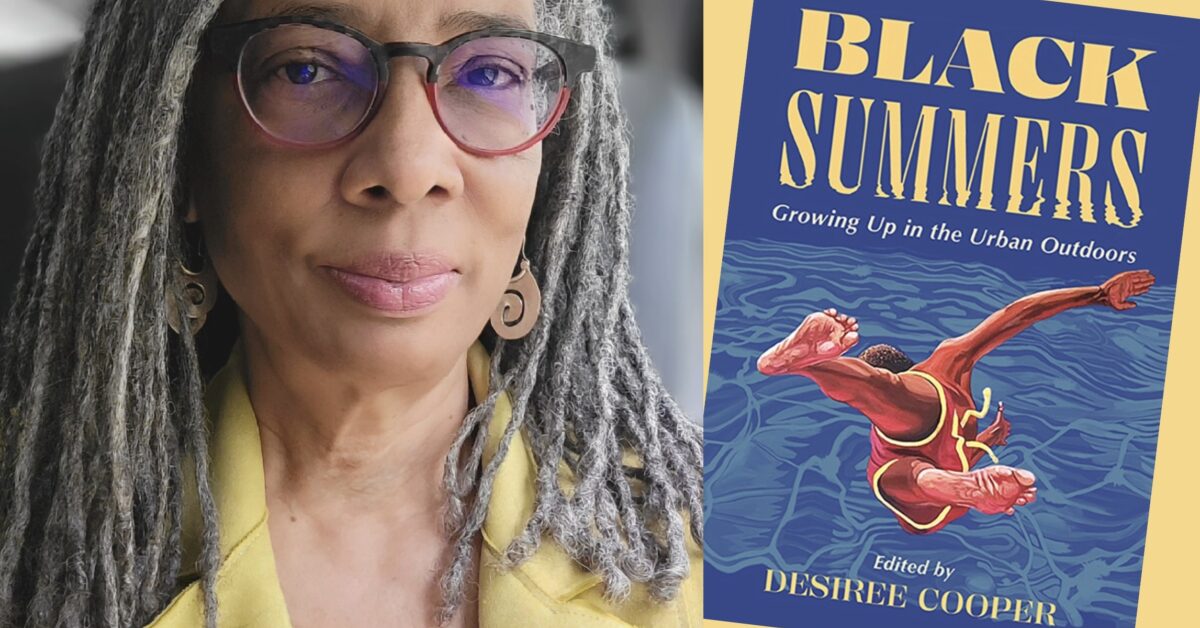

Summer is more than a season in “Black Summers: Growing Up in the Urban Outdoors," published recently by Wayne State University Press. Among the anthology’s 32 contributions of poems, essays, illustrations, creative nonfiction and even comics: a handful of queer-centered stories explore “glistening” basketball players, the thrill of “hide and seek” in Palmer Park and how a citywide blackout awakened a new journey of gender identity.
“How many times did I trek Palmer Park’s desire paths — and those paths veining the many other Palmer Parks out there — with men who’ve come to touch each other in all the ways this world cannot or won’t do?” ponders Tommye Blount in his story, “Desire Paths.”
Enjoying summer and coming to age in the late ’90s, MARS. Marshall, who identifies as nonbinary, yearns to step into his true self as an adolescent watching beautiful men play the sport he loves. “As a kid, I dreamed of being among them, my sweat-drenched body quick on the fast break, effortlessly laying the ball in the hoop,” they write in “Where the Run At.”
The image is unapologetically queer and unapologetically Black. And as a native Detroiter who grew up hearing of Boblo Island Amusement Park, the long shuttered Belle Isle tunnel, and feeling too gay, too Black or not Black enough for certain spaces, there is an emotional nuance in these varied stories for many LGBTQ+ people — even if some events took place decades ago.
Embedded in the book is also a sense of pride for all things Detroit, and Pulitzer Prize-nominated editor Desiree Cooper masterfully shapes the anthology’s stories into seamless memories that punctuate summer in the city from the ’50s to present day.
“I'm not really talking so much about documenting, ‘Black people are joyous people,’” says Cooper, who arrived in Detroit in the ’80s and spent 30 years living with a front seat to queer culture in the University District and Palmer Woods before she relocated South. Yet she still remembers the feeling of living in Detroit vividly.
“I'm more interested in documenting what we count as joy, what we feel is joy,” she says.
In Brittany Rogers’ poem, “Black Out, August 2003, Detroit,” there is also peace in the face of citywide darkness during the Northeast blackout of 2003, which lasted anywhere from two hours to four days depending on location. “What is it about the end of the world, makes you think you are owed an explanation?” asks Rogers with a line as relevant today as it was then.
On a recent sunny day at A.B. Ford Park in Detroit — as kids of all ages stormed the grassy fields outside in celebration of the warm weather — Cooper invited a handful of the book’s contributors to read and reveal the emotions behind their stories. The results were both funny and full-hearted as tears of joy flowed over cherished moments. Here, Cooper shares a few moments of her own about how the book came together, Detroit and why there is something for everybody in the city.
Reading some of the stories was bittersweet because it reminded me of just how isolating life can be without a car to visit popular neighborhoods and third spaces such as Belle Isle and Palmer Woods, especially when it comes to participating in queer life.
When I first moved to Detroit, I wasn't seeing it the way you're expressing it, but you're right. What were the outlets, you know? I know that there are places that were queer-friendly or queer-only. I understand that. But in the larger sense of the word, where was the place to let loose and just be part of the world? And that was before Pride. That was before Hotter Than July. I do think we want to be happy in the summer. We just really want to be happy.
There does seem to be a subterranean sense of joy in all the stories. In putting together the book, why do you think we remember summer with such rose-colored nostalgia? Is it because we spend so many months under snow and ice?
I’m going back to how I met summer in Detroit. My first years there, I was like, this is fantastic. I just loved how there was just so much about Detroit that no one ever talks about — and I was the new girl on the block coming in. I'm like, this is not anything like what I had read about this city; just how friendly it felt, and how happy it felt. There was a uniqueness around how people dressed, how they behaved, how they enjoyed the music, all the different food. No one would think chicken shawarma. How is that a Detroit thing? And pączkis! None of that was on my radar. So I was very, very surprised by the joy in this city, that it felt unburdened.
Then winter comes …
[Laughs.] Now when the winter came, I understood a little better how people were really kind of beat down by the gray, by the cold, and the things that are shut down, and the spaces look a little bit more foreboding. It's that Dr Jekyll and Mr. Hyde experience of the city.
I did limit [the book] to summer, and I did think, “Oh, I'm not going to be able to talk about Black folks who ski, or Black folks who ice skate.” But it's confined to summer because [this] conversation has been affirming what a joyous time that is, or that we hope for in the summer, and how nostalgic we are about what summer means.
But it’s not all sunshine and rainbows. The foreword pays tribute to the story of Sarah Elizabeth Ray, who fought discrimination all the way to the Supreme Court and won after being told to vacate the Boblo boat to Canada because she was “colored.” In today’s political climate, I think it’s a moment many marginalized groups can relate to.
There is definitely that double life experience that the larger society doesn't understand, the dangers of summer that come along with that joy. They don't understand how easily you can feel vulnerable, like a sitting duck, or like you're going to be humiliated out of nowhere when you're minding your business. You could be having the most innocent, wonderful time when that gets interjected. So I wanted to balance that, and I think most of the stories do touch upon this — this inclination to just let loose and have a great time and enjoy versus the trepidation of “how far can I go” or “what will happen if” that the majority culture does not have to think about.
What do you hope queer people take away from this book?
Maybe there's something about seeing how far a city, a group of people, has come. There's one piece I'm thinking about, “Desire Paths,” which is talking about Palmer Park, which is a very different place now than it was when it was part of cruising culture. I don't even know if it's a double-edged sword; it might be just a sword for the community that found that was the only place to go to meet. And now it's all family time and picnics, and it's a very different vibe.
Then you take someone like Brittany Rogers, whose poem was about when the grid went down in 2003 and there was a blackout across the Northeast. I wouldn't say it was speaking exclusively from a queer perspective. It's by a queer writer, and therefore, in my opinion, everything that they write is imbued with that. There's a lot of freedom to talk about a lot of things out in public happening when the lights are out, like, I'm safer now to just experience what is happening around me without feeling othered in that moment.
So, I do think that the stories show [how far] Detroit has come, that the community has come forward and provided safe spaces where people don't feel vulnerable and can be themselves. We have a long way to go, but they exist. Part of what I have said about this is: Because joy is having a moment, you got to find your joy. You got to do joy.
Is that the ultimate message for people who pick up this book?
Stake your claim. In this country, in these spaces, stake your claim. It's yours. I struggle with being hopeless, and I will tell you it was interesting because I was full of despair as this book was coming to press. But I was on the track. I was invested in the story. I believe in the stories that are there, and I love the way people came to the page and really dug deep and told their stories. They deserve to be heard. And so if it's going to take us an underground railroad of readers to get the book out, then we're going to build us an underground railroad and get the book out. It's exactly what the book is about. You have to invent your own path. We know that we can do that because we have — hand to hand, word of mouth, building platforms for our voices, our stories, our culture, demanding a spot where we have earned it, and it's ours.
Correction: A previous version of this article misstated MARS. Marshall's gender identity and pronouns. They are nonbinary and use they/them pronouns.
Read More
How the Detroit Disco Daddies Turn Queer Joy Into a Live Disco Spectacle
If you’ve ever gone out clubbing around Detroit and stumbled across two men dressed to the nines in disco attire, singing their hearts out to covers of hit [...]Read more about How the Detroit Disco Daddies Turn Queer Joy Into a Live Disco Spectacle
Michigan Celebrates First Transgender and Nonbinary Pride Month
Michigan's LGBTQ+ community is celebrating its first Transgender and Nonbinary Pride and History Month this August, an initiative born from one [...]Read more about Michigan Celebrates First Transgender and Nonbinary Pride Month
Democrats Are Trying to Disqualify Trans Candidates. Here's How.
This article was originally published by Uncloseted Media.Editor's note: Uncloseted Media is one of a growing number of independent, queer-led newsrooms [...]Read more about Democrats Are Trying to Disqualify Trans Candidates. Here's How.

Attend Transgender Pride in the Park, Go to Lesbian Camp, Experience Hot Fix Sideshow, Debut your Drag Act, Visit the New Pride Source Events Page
Summer may theoretically be winding down, but apparently nobody told Michigan's queer calendar. The next couple of weeks offer everything from an [...]Read more about Attend Transgender Pride in the Park, Go to Lesbian Camp, Experience Hot Fix Sideshow, Debut your Drag Act, Visit the New Pride Source Events Page

Michigan Supreme Court Clarifies Entrapment Standard After Stings Targeted LGBTQ+ Men
The Michigan Supreme Court has issued its opinion in People v. Jade, a ruling that reshapes how courts across the state must evaluate entrapment claims arising [...]Read more about Michigan Supreme Court Clarifies Entrapment Standard After Stings Targeted LGBTQ+ Men

17 Years After ‘American Idol,’ Adam Lambert Is Still Reinventing Himself
At this point, performing on a national stage is second nature to Adam Lambert, who shot to fame 17 years ago during the eighth season of “American Idol” in May [...]Read more about 17 Years After ‘American Idol,’ Adam Lambert Is Still Reinventing Himself