Haley Stevens or Abdul El-Sayed? Michigan's LGBTQ+ Voters Are Split
What Pride Source heard from both candidates, and why our readers can't agree
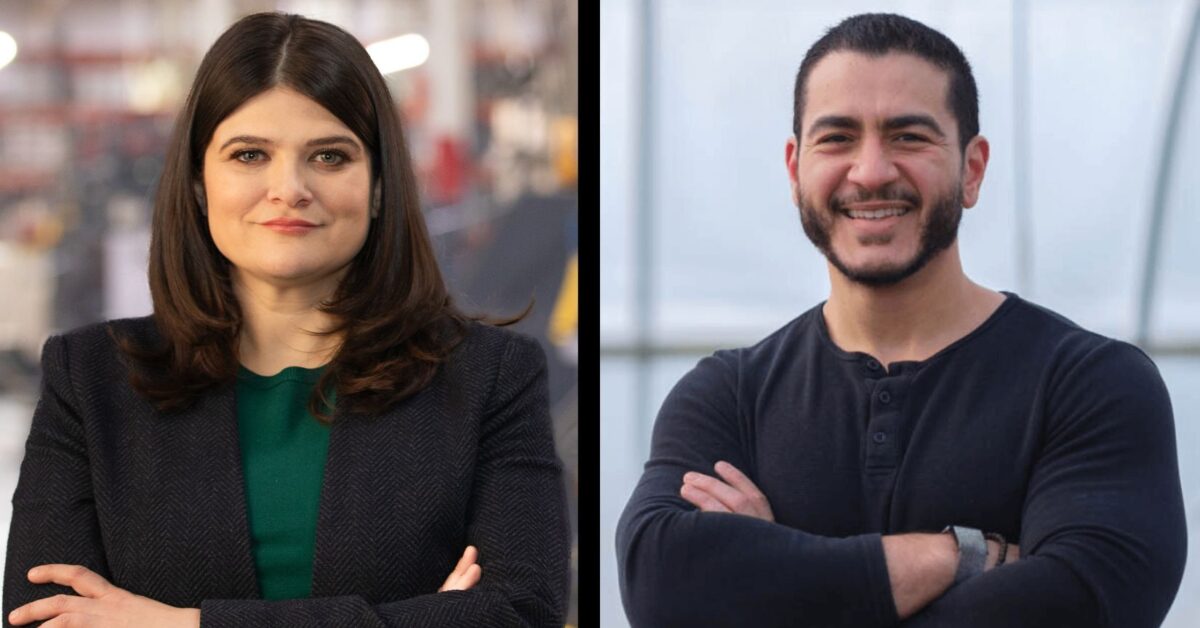

Ask two different left-leaning LGBTQ+ Michigan voters who they're selecting in the Aug. 4 U.S. Senate Democratic primary and there's a decent chance you'll get two different, strongly held answers.
The Democratic primary to succeed retiring Sen. Gary Peters has come down to U.S. Rep. Haley Stevens and Dr. Abdul El-Sayed, since state Sen. Mallory McMorrow suspended her campaign on July 5, and the choice between them has turned into one of the more heated debates happening inside our community right now.
Our interviews with the two remaining candidates drew heavy engagement on social media, with genuinely passionate disagreement in the comments. Some readers point to Stevens' legislative record as too significant to set aside given the current administration's continued targeting of LGBTQ+ people through executive orders and legislation, and among those readers are people weighing the race against real concerns for their own safety as members of the trans community. Others see her AIPAC-backed campaign as disqualifying on its own.
Meanwhile, readers drawn to El-Sayed point to his campaign as a shot at substantive structural change they see as critical in this political moment. Many supporters describe him as more trustworthy and more aligned with their own views on the war in Gaza, an issue that ranks at the top of their list. That split is part of why we sat down with both candidates.
Many Michiganders have already cast absentee ballots, which started going out June 25, or are preparing to vote early in person, with in-person early voting set to begin July 25. The most recent public polling, a Detroit News/WDIV-TV survey from July 8-11, showed Stevens leading 48% to 41%, with 10% still undecided, though the race tightens to a virtual tie among voters who say they're certain of their choice.
The snapshot:
Haley Stevens
- Four-term U.S. House member; voted to pass the Equality Act twice, secured $300,000 for Affirmations Community Center
- Backed by Senate Democratic leadership, EMILYs List, Michigan AG Dana Nessel and named to Advocates for Trans Equality's 118th Congressional Champions list
- Longtime "pro-Israel Democrat" who's called herself a "Zionist"; backed by AIPAC's super PAC
- Wants to use a Senate seat to force Republicans to vote on the record on anti-equality measures
Abdul El-Sayed
- Former Detroit and Wayne County health director; built HIV/PrEP infrastructure and ran the state's largest Ryan White program
- Backed by Bernie Sanders, AOC and the UAW; takes no corporate PAC money
- Made opposition to AIPAC funding and unconditional military aid to Israel a central campaign message
- Wants to bring his public health expertise to reverse Trump-era cuts to HIV and PrEP research funding
Pride Source sat down separately with both candidates ahead of the primary. Here's what they told us, organized around the issues Michigan Democrats say matter most in this race.
Where they stand on LGBTQ+ legalization and representation
Stevens points to her legislative record
The four-term Birmingham congresswoman voted to pass the Equality Act, which would add sexual orientation and gender identity as protected classes under the Civil Rights Act of 1964, when the House approved it in both 2019 and 2021. Both times, the bill died in the Senate without the 60 votes needed to clear a filibuster, and Stevens said she will continue fighting for the bill in the upper house.
Stevens was named to Advocates for Trans Equality's 118th Congressional Champions list. Ferndale’s Affirmations gave her its Lorna Utley Outstanding Ally Award in October 2024, months after she secured $300,000 in federal funding to help bolster the center's mental health offerings, funding she says she pushed through as Republicans were stripping the words "LGBTQ" and "equality" from other budget line items around it.
She points to a lame-duck House floor vote at the end of 2024 as the moment that best captures how she operates in a hostile Congress. Republicans had attached what she called an anti-equality "poison pill" to healthcare legislation, and colleagues urged her to vote for it anyway on the grounds that it would still help families. She voted no.
"I looked at my colleagues and looked over at the other side of the aisle and said, 'In this new dynamic with Republicans running the House, Senate and White House, all I have is my vote, and I'm going to use it accordingly. I'm going to stand up to hate and anti-equality measures wherever I see it, because they are playing games and the intent is to hurt people,'" Stevens said. Other colleagues joined her, in part because she went first. "I did it very intentionally to lead for the rest of my caucus in that time. I do not regret my vote for a minute. I do not regret any time I'm enabled to be courageous alongside people who need courageous voices and representation in critical moments."
Stevens also points to her seat on the House Education and Labor Committee as a front line most voters don't see. "I'm a daughter of a public school teacher," Stevens said. "I have spent four terms on the House Education and Labor Committee. I have sat in committee hearings and markups where very conservative members of Congress force votes that are anti-LGBTQ, talking about stripping mental health resources on college campuses for members of the community."
Sign up for more information about the LGBTQ+ for Haley campaign group here.
El-Sayed focuses on larger discrimination battle and his pro-LGBTQ+ public health record
El-Sayed’s case to LGBTQ+ voters is built on what he did running two Michigan health departments. Appointed in 2015 to rebuild Detroit's Health Department after it was privatized during the city's bankruptcy, El-Sayed opened a new Detroit Public Health STD clinic the following year and ran the state's largest Ryan White program, the federal safety net that funds HIV care for low-income patients. The clinic's PrEP program, serving patients regardless of ability to pay, won the Michigan Department of Health and Human Services' Outstanding Achievement in HIV Prevention Award in 2017, the same year El-Sayed left to run for governor.
He ran Wayne County's Department of Health, Human and Veterans Services from 2023 to 2025, overseeing services for 1.8 million residents before resigning to run for Senate. There, he partnered with LGBT Detroit to train his staff on serving queer and trans residents. "I really appreciated their partnership," he told Pride Source. "The folks on our team really appreciated the opportunity to ask important questions to understand better from a different perspective and to build community with folks." Naloxone access also expanded under his leadership at both agencies, work he now points to on the trail as evidence that he understands harm reduction and sexual health policy from the inside, not just from a committee hearing room.
He also argues his medical background gives him a more specific read on health policy than most senators bring to the job, pointing to the current administration's cuts to HIV vaccine research and PrEP support as the kind of thing his expertise is built to fight.
El-Sayed doesn't claim lived experience with anti-LGBTQ+ discrimination as a straight Muslim man, and he told us so directly: "I don't know what it's like to be gay or to be trans, but I do know what it's like to be discriminated against." He's described his approach to political courtship more bluntly, calling himself "kind of allergic to pandering," a line he's used to needle politicians who show up to a community's cultural events for photos and disappear the rest of the year.
"If the government has the power to come for trans people today, it has the power to come for anyone tomorrow," he added. "You're all fighting the same battle whether you realize it yet or not." It's an argument he returned to more than once in the interview, framing LGBTQ+ rights not as a discrete issue but as the test case for how much power the government has to discriminate against anyone. "One of my trans endorsers told me something I'm never going to forget, which is it's important for us always to be inclusive, and if they're taking aim, don't show them where to fire,” he said.
Follow the LGBTQIA+ for Abdul page on Facebook to learn how this group is campaigning for El-Sayed ahead of the primary.
How they'd use a Senate seat
Both candidates were asked what changes for LGBTQ+ advocacy if they advance to the Senate. Their answers point to two different theories of the job.
Stevens frames a Senate seat as leverage, specifically the power to force Republicans to go on record. "One of the key differences between the House and the Senate is the weight of the role and the ability to force amendment votes on any piece of legislation," the current House member said. "We see the Republicans grossly doing this on the anti-equality agenda, and I am questioning why we aren't putting it right back in their face. Why are they so outwardly being rewarded for discrimination and bias?" She described wanting to "link arms from the local level to the state level and to the federal level with advocacy organizations to be the senator that the community deserves."
El-Sayed frames it as expertise, specifically his own. "I can bring my expertise as a public health doctor and health director to making sure that we are bringing back online support for anti-HIV efforts, harm reduction efforts, investments in things like PrEP and research around an HIV vaccine," he told Pride Source, pointing to the current administration's cuts to HIV vaccine research and PrEP funding as the kind of damage he's positioned to undo. "Who doesn't want a vaccine for a deadly disease?"
Israel and Gaza: the sharpest divide
This is where the two candidates differ most, and it's become one of the most expensive and visible fights in the race, drawing national attention to Michigan’s senate race. AIPAC's super PAC, United Democracy Project, has spent close to $30 million supporting Stevens or opposing El-Sayed, who has taken no corporate PAC money, according to federal disclosures reviewed by Bridge Michigan — more than half of all outside spending in the race. AIPAC helped elect Stevens in 2018 and reelect her in 2022, and she's long branded herself a "proud pro-Israel Democrat." At a Senate primary candidate forum earlier this year, she went further, calling herself a "very passionate Zionist" who supports "dignity for all peoples and states."
Stevens has not disavowed AIPAC's support, though she has largely avoided discussing the group by name. "No one owns my vote, and no one owns my policies," she said at the candidates' July 7 debate in Grand Rapids. She has also criticized Israeli Prime Minister Benjamin Netanyahu directly, saying he "has not made us safer, has not brought us closer to peace, and he's endangered Jews here in America and around the world," and says she backs a two-state solution and continued humanitarian aid into Gaza.
Stevens’ voting record complicates that framing somewhat. She has consistently voted to fund Israel's military, including a $26 billion emergency aid package in 2024, and voted to sanction the International Criminal Court over its arrest warrant for Netanyahu in 2025. On July 15, she was among 314 House members, including 98 fellow Democrats, who voted against a Massie-Khanna amendment that would have stripped $3.3 billion in annual military aid to Israel from a State Department spending bill. The amendment failed, but 103 Democrats, including former Speaker Nancy Pelosi and Democratic Whip Katherine Clark, broke with leadership to support it. She has also said she will "continue to advocate...for the ceasefires in Gaza and Lebanon to hold, for more humanitarian aid, and for a lasting peace" that includes an independent Palestinian state.
El-Sayed has made opposition to AIPAC's spending and to unconditional military aid for Israel a central campaign message, calling Israel's actions in Gaza a genocide and AIPAC's spending on Stevens' behalf "legalized bribery." At the debate, he pressed Stevens directly: "Explain what you've given away for AIPAC support in this race." His campaign is running ads featuring Stevens’ comments on her ties to AIPAC and Israel.
Michigan Democrats are watching closely, and the funding question in particular appears to shape how much they trust a candidate more broadly. A Data for Progress poll of 515 likely Democratic primary voters, conducted in April, found 64% said they'd be less likely to support a Senate candidate who takes donations from AIPAC or other pro-Israel groups, compared with just 10% who said it would make them more likely. The same poll found 62% agreed with the statement that a candidate unwilling to stand up to AIPAC is less trustworthy on other issues generally, with only 13% disagreeing.
Affordability and healthcare
Beyond Israel, the issue Michigan Democrats have named most consistently this cycle is the cost of living. A companion WDIV/Detroit News poll, conducted alongside the horserace numbers, found the appetite for systemic change in health care runs deep among Michigan Democrats. Asked whether they'd support moving to a single-payer, Medicare-style system covering everyone, 82.8% of likely primary voters said yes, with 64.2% saying they support it strongly. Only 9.6% were opposed.
That support held up even when the question got more pointed. Told that switching to single-payer would mean people currently covered through an employer or union would lose that coverage and move to the federal system instead, support dropped, but not by much: 66.5% still backed the change, compared with 21.5% opposed.
Stevens ties affordability directly to LGBTQ+ discrimination in her answer to Pride Source, arguing the two compound each other. "When we have outright discrimination happening in society, it makes the affordability crisis all the more taxing,” Stevens said. “Think about the layers: housing, groceries, jobs, access. I've been part of efforts in Ferndale for affordable housing, particularly for the LGBTQ+ community. These things are connected."
El-Sayed's pitch centers on universal healthcare and getting corporate and PAC money out of politics, a message he's paired directly with his no-corporate-PAC campaign pledge as evidence that his other policy commitments aren't for sale either.
Where they agree
Both candidates say they'd vote to pass the Equality Act a third time if elected, and both say they oppose the Trump administration's rollback of federal protections for transgender Michiganders. Where they part ways is on what it takes to actually deliver on that goal.
Stevens points to a record of legislative wins, funding secured, votes cast and awards from advocacy groups.
El-Sayed's claims that a senator beholden to AIPAC or corporate PAC money can't be trusted to hold the line on any issue, LGBTQ+ rights included, once that funding is on the line. "If the government has the power to come for trans people today, it has the power to come for anyone tomorrow" is as much an argument about who's in the room making decisions as it is about trans rights specifically.
With roughly a third of primary voters still undecided or persuadable, that argument is still very much live heading into August.
Read our full interviews with Rep. Haley Stevens and Dr. Abdul El-Sayed, and visit vote411.org to find your sample ballot and confirm your voter registration before Aug. 4. Visit our election resource page for candidate profiles and other election-related news.
Read More

A Michigan Farm Stand Became a Safe Haven for LGBTQ+ People in Rural America
On a farm stand in Charlotte, Michigan, in a county that voted for Donald Trump by a wide margin in 2024, Sarah and Kim Padilla hung a Pride flag and waited to [...]Read more about A Michigan Farm Stand Became a Safe Haven for LGBTQ+ People in Rural America

Trump Is Targeting the Smithsonian. My LGBTQ+ History Is Inside It.
There’s been something troubling me for the last couple of years about what the Trump administration has been doing. It affects me personally, but I’ve mostly [...]Read more about Trump Is Targeting the Smithsonian. My LGBTQ+ History Is Inside It.

A Lifeline for LGBTQ+ Students in Michigan Schools Is Running Out of Money
For 25 years, the Michigan LGBTQ+ Students Project has worked to make schools safer for the state's LGBTQ+ youth, at a moment when many of those students [...]Read more about A Lifeline for LGBTQ+ Students in Michigan Schools Is Running Out of Money
El-Sayed Turns Tables on Watters in Fiery Fox News Clash Over Trans Healthcare
Michigan Democratic Senate candidate Abdul El-Sayed used an unlikely question to expose what he called conservative hypocrisy on medical decisions for minors, [...]Read more about El-Sayed Turns Tables on Watters in Fiery Fox News Clash Over Trans Healthcare

November 1996: Pilgrimage of Remembrance: Michigan Residents Join Thousands for D.C. Quilt Display
I am grateful to have documented the perspectives of different Michiganders who made the pilgrimage by chartered bus: A gay man from Battle Creek there to honor

June 1995: Summer Fashions
We wanted a queer, feminist revolution. We understood that a newspaper would be a fulcrum for that radical vision. And it was.