Gretchen Whitmer Reflects on Her LGBTQ+ Legacy (So Far) and the Gay Daughter Who Shaped It
From civil rights protections to Pride hugs, the 49th Michigan governor talks trans rights, political risk and the rainbow-filled wardrobe her daughter teases her about
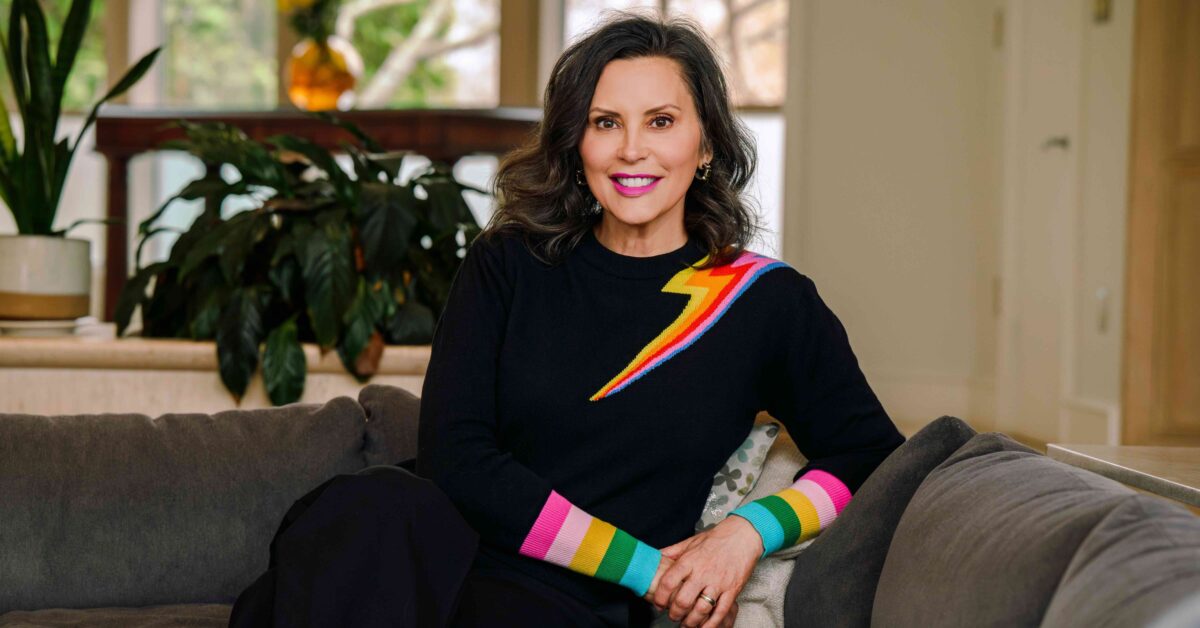

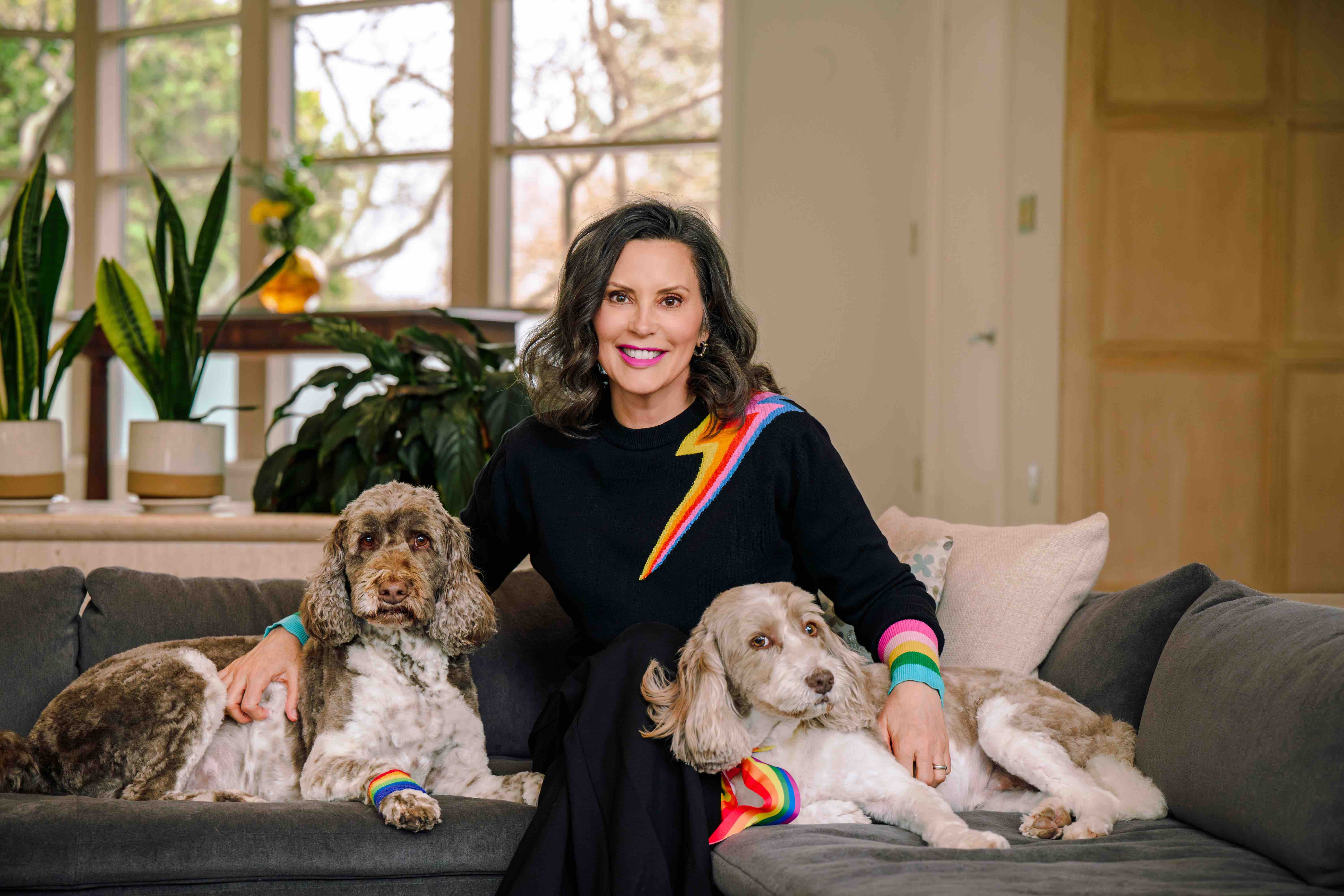
Gov. Gretchen Whitmer isn't just a regular mom — she's a cool mom. She'll tell you herself. Or rather, her outfit will. She strides into the living room of her Lansing residence in all black, a rainbow lightning bolt off one shoulder, rainbow colors climbing each sleeve. The sweater was originally a gift from Whitmer to her gay daughter Sherry, who didn't want it.
"My daughter laughs at me. I'm that mom who buys her the rainbow stuff and she's like, 'Gretchen, please,'" Whitmer says, clearly relishing this. "She doesn't always call me Gretchen, but when she's criticizing me, she does.”
“I bought this for her and she was like, 'You're ridiculous.' I'm like, 'I love it. I'm going to wear it.' I am 'That Mom' on TikTok. I always get compliments on it. I told her if she wants to steal it back, she can." It's a TikTok type she wears proudly — the mom who goes harder for her gay kid than the kid wants her to.
She carried that energy into the photo shoot, pausing to grab rainbow accessories for her dogs, Kevin and Doug, before pulling them onto the couch so the three of them could pose together — all of them dressed for Pride. As for the sweater, so many people wish they had it. Right after my sit-down with Whitmer in April, we posted a preview photo and the internet lost its mind. How many governors can say that?
Whitmer's cool demeanor runs deeper than a statement fit. It's rooted in a fierce protectiveness she has demonstrated throughout her life — most visibly as Michigan's governor since 2019. For anyone who finds politics a bitter pill, Whitmer is the cold beer chaser. She doesn't just show up to your Pride party; she throws her own. Her creative director Julia Pickett, an out lesbian who hung out nearby during our interview, makes sure that energy translates online. Their collaborations have given Whitmer's social media presence its distinctly queer-fluent wit.
During a 2023 phone interview, I suggested to Whitmer that she be transformed into a drag king named "Gretchen Whitman." It came up again at her house, and she didn't just roll with it — she seemed to love the idea, ready to make it happen like so many queer-affirming things she’s already made happen. She looked to Pickett: "I fully support," Pickett said. Whitmer didn't miss a beat: “We have to go big for my last Pride as governor.”
But Whitmer doesn't just wear her allyship on her sleeve. As Michigan governor, she's gotten to do what every ally mom wishes she could: sign legislation that protects not just a community of people she cares about but her own kid too.
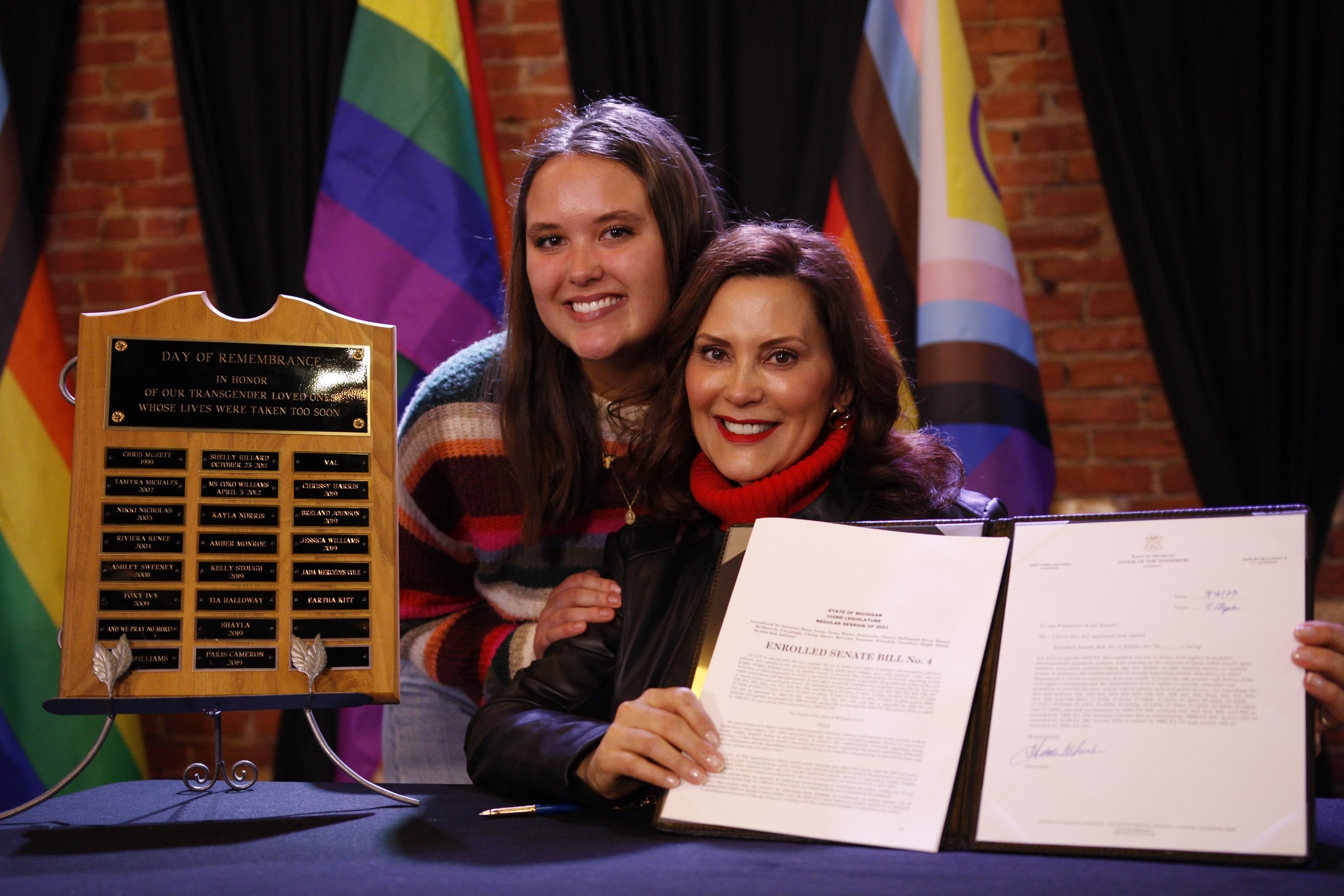
In 2023, Whitmer recalls having Sherry by her side as she signed the Elliott-Larsen Civil Rights Act (ELCRA) amendment, explicitly adding sexual orientation, gender identity and gender expression as protected classes. “I didn't know that I was raising a gay woman,” says Whitmer, who didn’t know Sherry was gay until she came out just before heading off to college.
“I became a member of an LGBTQ+ family in my nuclear family and signing that law so that she would be protected, as would everyone else in the LGBTQ+ family, felt really good,” she says. “I’d fought for that for many years and then to be able to sign it into law with my daughter standing there was really a powerful moment.”
Before the signing, Whitmer admits she was a little too formal in asking Sherry how she should be addressed during it. "Can I refer to you as a member of the community?" she remembers asking. Sherry texted back: "LOL, Gretchen, you're ridiculous." Whitmer fretted — what did she do wrong? "And she just said, 'You refer to me as a gay woman or a lesbian, please.'" Whitmer responded: "Thank you for the advice, gay woman." Sherry's reply: "You're welcome, non-community member."
During her tenure as governor, Whitmer says she's learned a lot from her own gay child — but also from staffers who "keep me current" as well as, ahem, community members. She asked questions. She listened. She’s been unafraid to make mistakes. You see it even in conversation: When I ask her what new Pride tradition she'd love to see introduced, she turns the question back on me, genuinely curious about the answer. She responded positively to my idea of ensuring Pride festivals include an educational component so younger generations understand Pride didn’t begin as a celebration, but a fight for our rights.
Over the years, she’s also relied heavily on team members who make sure she's recognizing the transgender community in the right way at the right moments. "I'm grateful that I have them and they're willing to spend a little extra time with 54-year-old Gretchen who's got all the right motivations and maybe sometimes the wrong words," she says with a laugh.
Long before the law
For Whitmer, the fight for LGBTQ+ rights has always been personal. She remembers the stories that stuck with her: friends like Chris Kolb, the first openly gay legislator in Michigan, who came into office with her, or Richard Brown, who came out later in life, or Jeynce Poindexter, a trans advocate whose courage and resilience left a lasting impression. "I've learned so much from each of these people, but there are thousands of stories that I've been fortunate to learn from, and their experiences have helped me have more confidence in the work," she says.
It was those kinds of stories that shaped her understanding of the stakes. She recalls the heartbreak of people denied basic rights: partners kept from seeing loved ones in the hospital, parents stripped of custody rights, queer people fired from their jobs based solely on their identity. "Every person deserves to live the life they want with dignity and protection and respect, and that's the bottom line," she says.
My daughter laughs at me. I'm that mom who buys her the rainbow stuff and she's like, 'Gretchen, please.'
— Gov. Gretchen Whitmer
But her allyship didn't start with laws or executive orders. It started with small, human moments — moments that Cody Barnhart still remembers, 24 years later.
In the summer of 2002, shortly after graduating high school, Barnhart, then 18, served as a page in the Michigan State House of Representatives, where Whitmer was then a state representative. Pages mostly ran errands and stayed out of the way, he recalls, but Whitmer stood out for a simple reason: she noticed them.
“A lot of representatives saw pages as part of the furniture,” he says. “But she made a point to engage with us as individuals. For a teenager in that environment, that kind of acknowledgment leaves an impression.”
A few years later, at his first Pride celebration on the steps of the Capitol, that impression deepened. Newly out and unsure of where he fit, he slipped inside the building, overwhelmed by the crowd. Whitmer happened to be there preparing to give a speech.
“She recognized me right away,” he recalls. “When I told her I was nervous to go back out, she didn’t push me. She just asked if I wanted to stand outside with her so I could feel like I was part of it.”
He watched her speak from just off to the side, trying to look like he belonged. For the first time, he says, he actually felt that he did.
“That small gesture meant everything,” he says.
Years later, after enlisting in the Army during the era of Don’t Ask, Don’t Tell, he returned to Lansing with hopes of becoming a helicopter pilot. Whitmer, then serving in the Senate, wrote him a recommendation letter for his Warrant Officer application.
“I still have that letter,” he says. “She was that way when I was a teenager running errands on the House floor, and she was that way when I walked into her office years later as a soldier with a dream. That kind of consistency tells you everything.”
That consistency — personal as much as political — would later shape how she approached LGBTQ+ protections in law. By 2014, when Whitmer was a Michigan state senator, she was already operating under a principle that still feels urgent today: No one in this community gets left behind.
That year, ELCRA was close to reaching the finish line, though not as we currently know it. Republican Senate Majority Leader Randy Richardville, though well-intentioned according to Whitmer, told her the amendment could pass if transgender people were left out. She told him he didn't understand that this was a community. "We're never gonna go for that," she said — using "we" deliberately. "Are you telling me you'll vote against something that gives civil rights to lesbians and gay people?" she recalls him asking. "They would want me to," she said, "to make sure we don't go forward without the trans community — because they're uniquely vulnerable."
For advocates like Denise Brogan-Kator, that stance carried enormous weight.
As someone who had been fired from three jobs because she was transgender, Brogan-Kator, who served as Executive Director of Equality Michigan from 2010 to 2012, recalls how powerful it was that Whitmer insisted on the inclusion of transgender people.
“It meant she understood something essential: equality that excludes the most vulnerable is not equality at all. For me, and for many advocates, it was both deeply personal and politically significant. It said that transgender people were not expendable, not an afterthought, and not people who should be told, yet again, to wait our turn.”
“Too often there is pressure in movements like ours to accept a partial win and sacrifice the people who are least understood or most politically vulnerable,” she adds. “Her stance rejected that. It signaled real allyship and real moral clarity, and it matters enormously.”
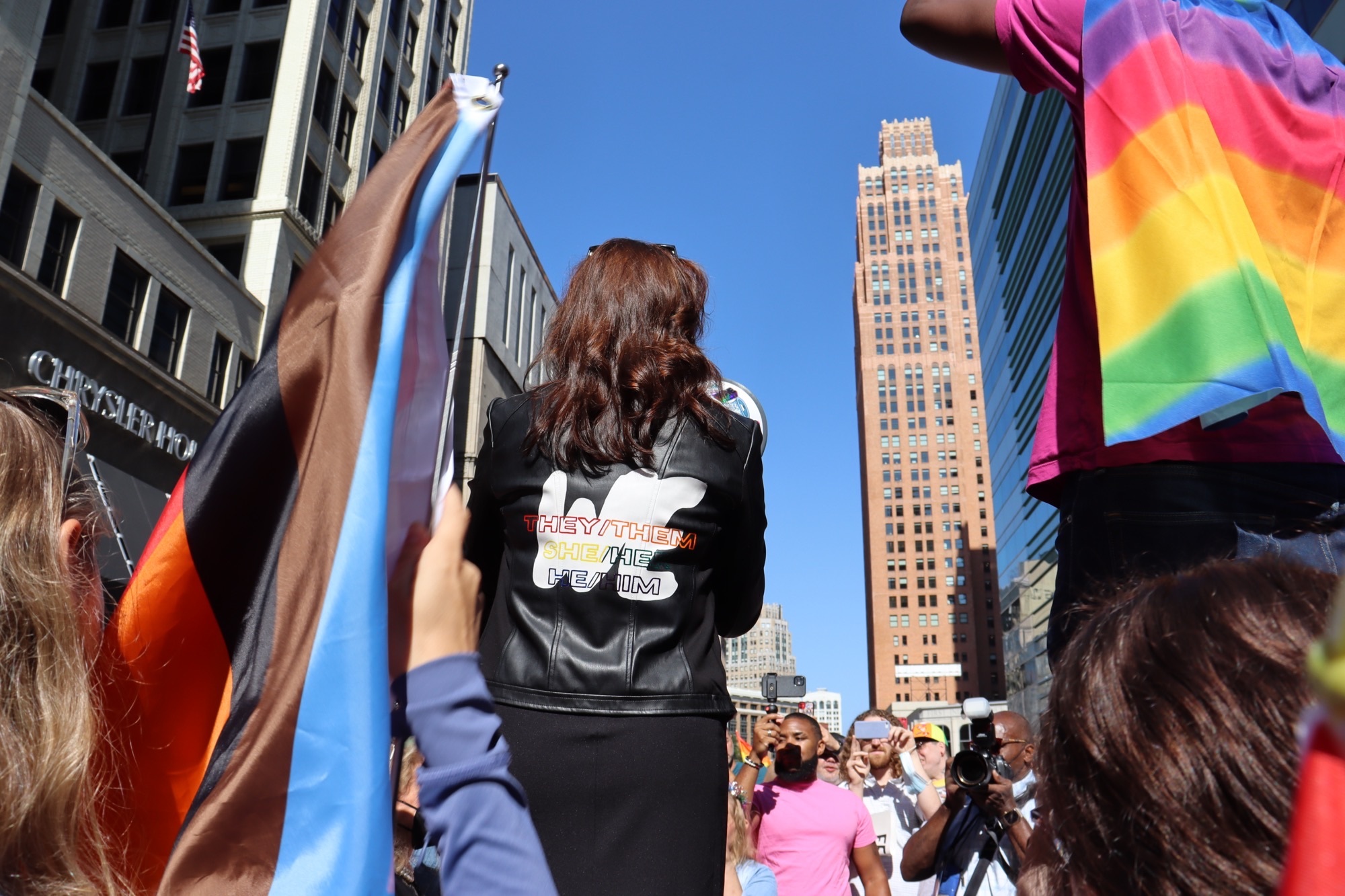
Those early conversations between Brogan-Kator and Whitmer helped set the stage for what would eventually become the ELCRA amendment.
Brogan-Kator recalls that, before Equality Michigan could focus on marriage equality, which was gaining momentum nationally, this amendment to allow LGBTQ+ Michiganders to “participate in everyday life without fear of being fired, denied housing or otherwise excluded because of who they were” needed to take priority. When she met with Whitmer, she laid out the case for amending ELCRA, but also shared her own story about how the lack of protections affected her.
“She did not respond with platitudes,” Brogan-Kator recalls. “She asked pointed, practical questions. Did we know how widespread the problem was? Could we mobilize our constituency? What was our strategy for building support? We talked about organizing in cities and towns across Michigan, in part by passing local non-discrimination ordinances, both to protect people where we could and to build momentum for statewide change.”
Whitmer promised her full support and spoke candidly at the time: that amending ELCRA would be difficult with anti-LGBTQ+ forces controlling state government. “I had a tough legislature,” she says of her first year as governor. “I stood on principle and was able to get some things done through executive directive, but I didn't have a legislature that was going to work with me to codify Larsen, for instance. They were fighting me on all sorts of things. It was an overwhelmingly Republican, anti-LGBTQ legislature.”
That dynamic shifted in 2022, when Democrats swept statewide elections and gained full control of the Michigan Legislature for the first time in nearly 40 years.
Those early meetings left Brogan-Kator certain: Whitmer would stand firm when it mattered most. “I left them believing she was a strong supporter who would use her voice to defend our rights to employment, dignity and non-discrimination,” she says.
Nearly a decade later, Whitmer delivered.
What she leaves behind
At a time when LGBTQ+ protections are being stripped away in states across the country, Whitmer has offered something that can feel rare: proof that progress is still possible. What Michigan has accomplished under Whitmer since 2022 carries even more weight when viewed against what’s happening elsewhere. The stakes now couldn't be higher. In 2025 alone, the ACLU tracked 575 anti-LGBTQ+ state bills — most of them aimed squarely at transgender people — and 54 became law, a new record. More than 850 bills targeting transgender people were filed that year, more than in any other year in American history. The progress Michigan has made isn't happening in a vacuum. It's happening in spite of everything.
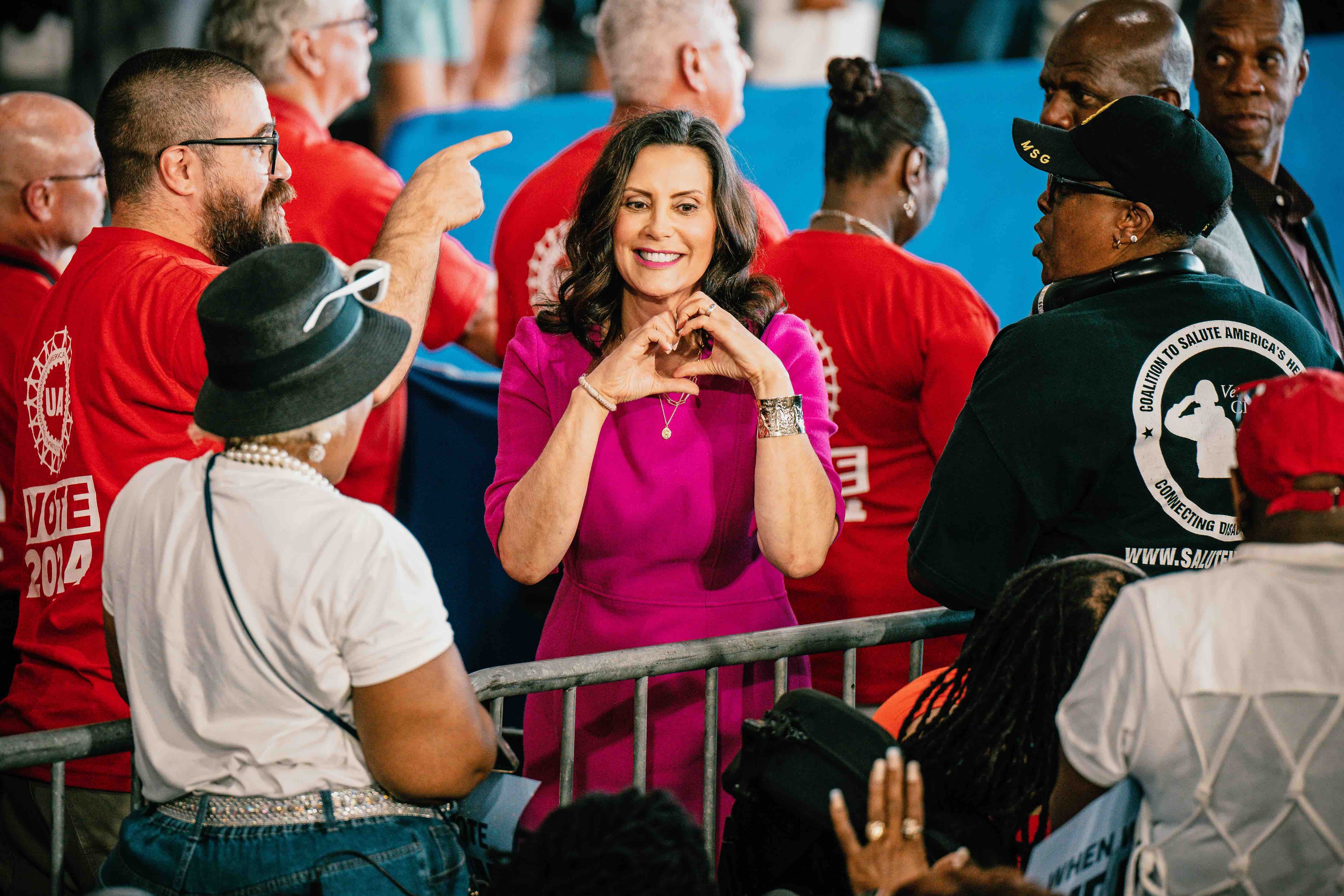
So how do you know the work you’re doing matters, in a state that’s moving forward while much of the country seems to be moving backward? Whitmer points to the moments that can’t be captured in headlines: the hugs she’s received over the years, many as she moved down the line at Motor City Pride. Even when the legislature wasn’t working in her favor in 2019, she saw the impact firsthand.
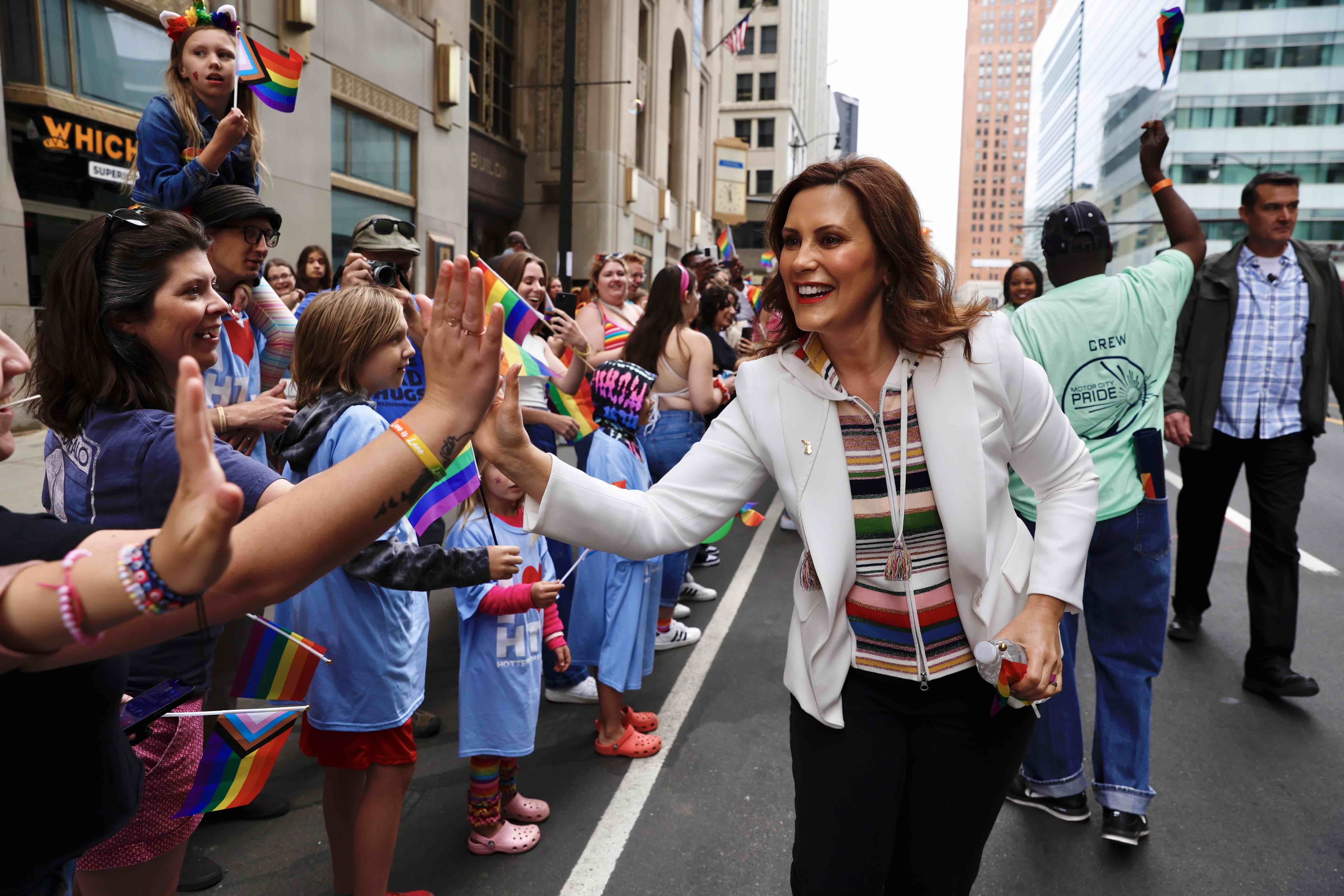
To show up at Pride events and just that power of showing up and using the platform, I saw how impactful that was and important. I’ll never forget that. And the hugs. People say, 'Can I hug you?' And some people would have tears that a governor showed up, much less be there to warmly receive and listen.
She felt the “depth of the meaning of it” — a reminder of “how people do feel excluded.”
It was like a release for them. They felt protected,” she says. “And that, for me, said, 'OK, that’s my job. That’s what I’m here to do: to help, to protect, to support, to uplift.'
Her impact was felt recently with her final State of the State address in February 2026, when Whitmer made a point to speak directly to the LGBTQ+ community — notably the trans community — just one day after President Donald Trump continued his attacks on trans people.
“I want you to know that you are welcome in Michigan,” she said. “You belong, you matter, and no matter who comes after you, I’ll stand in the way.”
She tells me the feedback was “overwhelming,” that community members expressed gratitude for her “staying there when it feels like some allies have gotten quiet.”
“What we've done has not just been noticed, it's been meaningful,” Whitmer says. “And I think that's the most important thing. I'm not here to play games. I want to do meaningful work. I want to make real progress. And when I get that feedback from the community and allies of the community, it tells me we've had that real impact."
That impact has extended beyond Michigan to a national platform. When Donald Trump dismissed her as “that woman from Michigan” in April 2020 — as Whitmer enacted safety measures during the COVID-19 pandemic — the phrase didn’t diminish her. She claimed it. Soon, it became a viral rallying cry.
It’s a moment she points to when asked when she first realized her voice carried beyond state lines. Suddenly, people across the country were paying attention — not just to her pandemic response, but to what she did with that attention afterward, including actions on issues like conversion therapy. That realization sharpened when she was a featured speaker for the Annual Democratic National Committee LGBTQ+ Gala in New York in 2025, where attendees approached her about her work on LGBTQ+ issues.
“I assume Michiganders know who I am, but it was really a surprise to find out that others did too. That was one of those moments that it was like, ‘Oh my god, what I’m doing — this platform — is a lot bigger than just Michigan,’” she says. “‘And when it comes to responsibility, use it right.’” As governor of the 10th most populous state in the country, she feels that weight acutely, especially since "there's so much hate coming [out of] Washington D.C. right now — and ignorance. I think it's even more important than ever that those of us who have a place of leadership need to use that place."
With the White House amplifying anti-trans rhetoric and rolling back protections, the threat to trans lives has become both political and literal. In 2024, when I spoke with Whitmer, just after the death of Ashia Davis, a trans woman killed in Highland Park at the start of Pride Month, I asked what our state can do to address the epidemic of violence against trans people. She was blunt and action-oriented: “So much of our work is around coalescing allies, raising voices and educating the public. But also holding those who inflict harm on, or murder, members of the community accountable.”
Early the following year, that accountability took a concrete form with the passage of the Michigan Hate Crime Act. The law clarifies what counts as a hate crime and puts meaningful penalties on the books, criminalizing acts from physical violence to property destruction when motivated by bias.
Threats on the horizon
In January 2027, when Whitmer leaves office, a lot could change — we've seen it happen federally to detrimental effect. Her ability to maintain lines of communication across the aisle — including with the current administration — has been both a political asset and, for some in the community, a source of unease. Whitmer has been direct about the tension herself: “I know that there will be times when we're not on the same page and we'll be at odds," she told Bridge Michigan in 2025, "but if I can find common ground, I'm going to do that.” She's also been equally clear about the limit: "I will fight back when I need to." During our interview, Whitmer is starkly honest about this when asked if she worries that the work she's done to protect the rights and safety of LGBTQ+ people through legislation could be completely undone.
"Absolutely," she says, bluntly. "These policies have to transcend a change in administration. Obviously, an administration that shares these values coming in is going to be really important to me. I'm going to work my tail off to make sure that that happens.”
While I'm not going to be serving as governor after the end of this calendar year, I ain't going anywhere and I'm not leaving the fight,” she says, like she means every word of it. “And I've got a lot of gas in the tank. I don't know how exactly I'm going to expend it, but we've made a lot of progress and I'm determined to make sure we don't go backward.
— Gov. Gretchen Whitmer
“No matter who it is, though, it's on all of us to keep the pressure on in Lansing and in Washington D.C. to elect people who will do the work and be unapologetic about it, but also be smart operators about getting stuff done,” she adds. “I love a candidate who's got all the same values, but we need a candidate who has that and knows how to get things done."
She's already acting on that. Whitmer has endorsed state Sen. Jeremy Moss in his bid for U.S. Congress — and the choice reflects her priorities. As Michigan’s first openly gay state senator, Moss has helped lead many of the state's recent LGBTQ+ policy efforts, including Senate Bill 4, which amended ELCRA. "I'm honored to have her early endorsement for my congressional race, because I think she also sees value in breaking the LGBTQ+ barrier to make sure we send our voice to Congress for the first time," he says. “My goal is to train and elect as many LGBTQ+ members and allies into positions of power across different governmental levels," Whitmer says.
The momentum is real. So is the threat. In March 2026, the Supreme Court voted 8-to-1 to dismantle Colorado's ban on conversion therapy for minors, siding with a Christian therapist who argued the law violated her First Amendment rights. It was a gut punch — and a warning. The majority, written by Justice Neil Gorsuch, didn't rule that conversion therapy works. It ruled that Colorado's ban unconstitutionally restricted what licensed therapists could say, a First Amendment framing that now threatens similar laws in more than 20 states. Michigan is one of them.
"The actions that we took on conversion therapy ban is something that will continue to be a part of public discourse as we see what's going on in D.C. right now,” Whitmer says.
The ruling only sharpens the urgency. "It's frustrating to see challenges to what is really just good, smart policy and what happened to the Colorado law I'm worried will then be applied to Michigan law.”
For trans Michiganders specifically, the threat has moved beyond the courtroom and into the clinic. In August 2025, federal pressure alone — a subpoena, the threat of a criminal investigation — was enough to make University of Michigan Health stop providing gender-affirming care to minors, even though that care remains legal in Michigan and recognized as best practice by major medical associations. No court ordered it. The law hadn't changed. As Erin Knott, executive director of Equality Michigan, put it, the university had simply "chosen to retreat." Attorney General Dana Nessel went further, calling the move "shameful, dangerous and potentially illegal" under Michigan's own antidiscrimination laws.
“[These threats] reinforce for me that these fights are never over. We can't slow down. We can't give up. We have to keep going, putting one foot in front of the other and using every tool we can to do the right thing,” Whitmer says.
‘A lot of gas in the tank’
Many of us have felt the reach of Whitmer's work differently — in practical terms, in symbolic ones, in the quieter register of simply knowing someone in power is genuinely watching out for you.
When I first sat down with Gov. Whitmer, I was at a loss for words. Maybe, in her presence, on the receiving end of one of her Pride hugs, you've been there yourself. Part awe, part gratitude — I was conscious of being both a gay person she has actively protected under the law, and a journalist who's supposed to keep his composure. As I tried to express the emotions I was feeling, knowing how soon she'd be leaving office, she offered a calm “you're good, don't worry” — and I recognized something I'd seen described in account after account: Her allyship isn't performed. It's just present.
Barnhart, the former House page, has known this about her for two decades. Now 42, he still returns to the same observation he made at 18: Her kindness was never a calculation. "I've encountered plenty of politicians over the years," he says, "and one thing I've noticed is how skillfully many of them can shift their positions to match the moment — and then reframe history to make it seem like they were always on the right side. Gretchen was never like that. Supporting LGBT people in 2002 wasn't popular, and it wasn't safe. She did it because it was right."
A clear illustration of that is her integration into the community itself — not as a guest of honor at a podium, but as a friend showing up for a birthday.
Sen. Moss puts it plainly: "I'll tell you a true personal story."
It was the summer of 2021. Pandemic restrictions had finally eased enough for people to gather again in restaurants, to breathe the same air in the same room. "The first outing that Gretchen Whitmer herself made," Moss says, "was a birthday celebration for me." They went to Five15 in Royal Oak for drag queen bingo hosted by Sabin. The governor's first post-restriction night out wasn't a ribbon-cutting or a press event. It was a drag show for her friend's birthday. "I've been to drag shows with her a few times in Royal Oak," he says.
This wasn't 2015. In some ways, it felt closer to 2002. Drag has spent the last few years in the crosshairs of legislatures across the country. Yet again, she showed up anyway.
"What you see is what you get with her," Moss says. "There's no facade to break through. She is genuine. She is real. How she talks off the cuff, whether in a media interview or in person, is exactly who she is."
Barnhart has experienced that firsthand. Years later, during her second campaign, he attended a volunteer event where she spoke before they headed out to knock doors. She recognized him immediately — significant time had passed — and he had the joy of introducing her to his then-fiancé, now his husband. He vividly remembers her pulling him into a hug, then turning to the crowd and punctuating her call to vote homophobes out of office with an expletive.
"I love her for that," Barnhart says. "Not for the language, but for what it represents. She wasn't performing for donors or carefully choosing words for a press release. She was speaking from her heart, in front of a room full of volunteers who were there because they believed in her. That's the difference between someone who supports a cause and someone who actually lives it. She has always been the latter."
Now, as she leaves office in January 2027, her legacy has been woven into the laws she's enshrined with her signature. Moss is clear-eyed about what that means. "She's led on these issues and she's made them a priority — for just the moral reason of ensuring that our lived experience is valid and protected under the law," he says. "But she's also made the case that this has enhanced our entire state as a whole. It has been a benefit to Michigan economically and competitively to embrace the LGBTQ+ community and make it a welcoming state."
For Moss, the argument was never just about rights. "There is an economic and business case to be made that protecting LGBTQ+ people keeps Michigan competitive, keeps Michigan as vibrant as possible as a state in the country."
Knott puts the arc in focus. "Gretchen Whitmer's advocacy has meant that, for the first time in a long time, LGBTQ+ Michiganders have had consistent, visible support from the governor's office," she says. "That kind of steady leadership has helped shift the tone statewide from uncertainty to affirmation." What makes it matter, Knott says, is that it's no longer just symbolic. "Her legacy as an LGBTQ+ ally is really about making equality durable. Before this, protections often depended on interpretation or were vulnerable to being rolled back. Under her leadership, they've been codified into law. That changes everything — it gives people real recourse and real security."
Whitmer isn't finished. She still has the rainbow Hush Puppies she wears every year to Pride ("my supportive mom shoes"), still has Sherry's sweater (for now) — and still has a community she's not done fighting for. The cool mom, it turns out, is also in it for the long haul.
In December 2025, Whitmer was unanimously selected as vice chair of the Democratic Governors Association heading into the 2026 midterms, a role that puts her squarely in the middle of the party's national strategy — and keeps her name in circulation for 2028. She ruled out a run for the U.S. Senate seat left by Gary Peters’ retirement and has repeatedly shut down direct questions about a presidential bid, but she's also never taken herself out of the running. Political observers describe her posture as "strategic ambiguity" — keeping her options genuinely open while she decides what comes next.
While I'm not going to be serving as governor after the end of this calendar year, I ain't going anywhere and I'm not leaving the fight,” she says, like she means every word of it. “And I've got a lot of gas in the tank. I don't know how exactly I'm going to expend it, but we've made a lot of progress and I'm determined to make sure we don't go backward.
Because if you know anything about Gretchen Whitmer by now, you know she's not the type to leave a fight before it's won.
Read More

Christian Styles, Metro Detroit Adult Performer, Dies at 29
Christian Styles, a gay adult performer and content creator with Michigan roots, has died at 29. His family confirmed his death in an obituary stating he passed [...]Read more about Christian Styles, Metro Detroit Adult Performer, Dies at 29

Democrats Are Trying to Disqualify Trans Candidates. Here's How.
This article was originally published by Uncloseted Media.Editor's note: Uncloseted Media is one of a growing number of independent, queer-led newsrooms [...]Read more about Democrats Are Trying to Disqualify Trans Candidates. Here's How.

Michigan Supreme Court Clarifies Entrapment Standard After Stings Targeted LGBTQ+ Men
The Michigan Supreme Court has issued its opinion in People v. Jade, a ruling that reshapes how courts across the state must evaluate entrapment claims arising [...]Read more about Michigan Supreme Court Clarifies Entrapment Standard After Stings Targeted LGBTQ+ Men

Abdul El-Sayed Wins Michigan Senate Primary as LGBTQ+ Candidates Make Historic Gains
Dr. Abdul El-Sayed won Michigan's closely watched U.S. Senate Democratic primary Tuesday with 49% of the vote, narrowly edging out moderate U.S. Rep. Haley [...]Read more about Abdul El-Sayed Wins Michigan Senate Primary as LGBTQ+ Candidates Make Historic Gains

Expanded Blood Donation Rules Go into Effect
Starting Aug. 7, blood donation centers will implement new donor eligibility requirements that will open blood donation to individuals who were previously [...]Read more about Expanded Blood Donation Rules Go into Effect

Drag Queen Flamy Grant Rockets to Top of Christian Music Charts Thanks to Outraged Pastor’s Rocket Fuel
In news that sounds like satire, but is absolutely not, a drag queen has rocketed up iTunes' Christian music chart after a pastor she clapped back at [...]Read more about Drag Queen Flamy Grant Rockets to Top of Christian Music Charts Thanks to Outraged Pastor’s Rocket Fuel