How the Road to Federal Marriage Equality Ran Through Michigan
Keith Orr and Martin Contreras' 2014 wedding became part of the movement that reached the Supreme Court
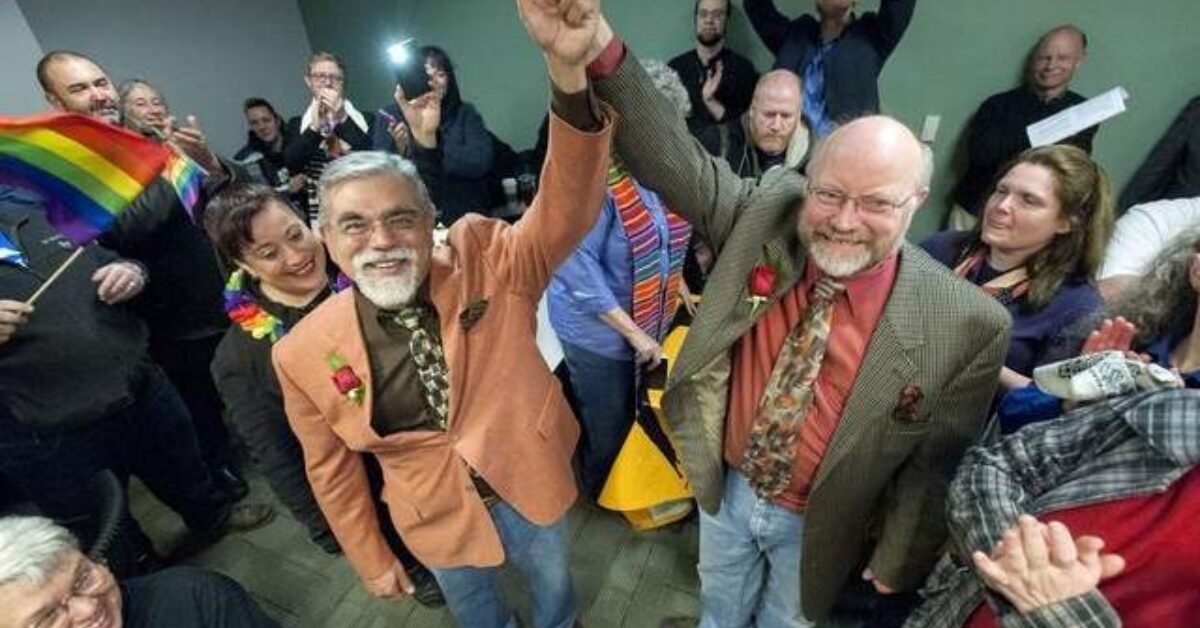

When Keith Orr first introduced Martin Contreras as his husband at the neighborhood gay bar they owned together during Sunday brunch in March 2014, he paused for dramatic effect. The dining room at Aut Bar in Ann Arbor’s Braun Court was overflowing with celebrants who had gathered to mark both the couple's wedding and Michigan's brief window of marriage equality. Even as they served the crowd, the newlyweds were still processing their own whirlwind day.
After nearly three decades together, Martin and Keith had finally been able to legally marry. Yet here they were, back at work, hustling between kitchen and dining room to feed a community that had come to celebrate with them — unaware they were toasting not just a wedding, but a legal revolution.
"Back in the kitchen is my husband Martin," Keith announced to the packed room, then mock-checked his wrist. "My husband of about two hours."
The applause that followed wasn't just for the couple's newlywed status — it was for a moment that seemed impossible just hours earlier. What none of the celebrants could have known that March day was that they were witnessing a pivotal moment in a legal battle that would reshape marriage equality nationwide.
The Michigan case that allowed the couple to marry would become the cornerstone of the decision that made marriage equality the law of the land just over a year later, when the Supreme Court ruled on Obergefell v. Hodges, guaranteeing marriage equality across all 50 states.
The path to that victory ran directly through Michigan, where couples like Keith and Martin were among approximately 300 who rushed to marry during the state's brief "window" on March 22, 2014. Their legal challenge, sparked by Hazel Park couple April DeBoer and Jayne Rowse's fight for adoption rights, would ultimately force the Supreme Court's hand and secure marriage equality for millions of Americans.
The reluctant grooms
When Martin and Keith met in 1986, marriage wasn't even on their radar. For Keith, coming out in the early 1980s meant rejecting what he saw as heterosexual constructs.
"Back then, when I was coming out in the late early ’80s, the idea of even getting married to a same-sex partner was not even something I imagined would ever happen in my lifetime," Keith recalls. "And not only didn't imagine it happening, but I didn't want it. It was like, ‘Why follow those straight constructs of what it means to have a relationship and a union and a commitment to each other?’"
That resistance wasn't uncommon in the LGBTQ+ community at the time. Many viewed marriage as a straight convention that didn't fit their lives or values, with influential voices like legal advocate Paula Ettelbrick arguing in her famous 1989 essay "Since When Is Marriage a Path to Liberation?" that marriage was "antithetical to my liberation as a lesbian and as a woman because it mainstreams my life and voice." As law professor Nancy Polikoff recalled in a 2013 Salon interview about the community’s viewpoints on marriage equality in the ’70s, "There was a significant contingent of people who identified as feminists who said, 'This is the wrong approach, this isn't what we should be doing.' That viewpoint carried the day for a long time." Keith admits he, too, "had to be convinced that gay marriage was something that was good for me or for us."
The turning point came when marriage equality advocate Evan Wolfson held events at Aut Bar and the couple’s other Ann Arbor business, Common Language Bookstore. Wolfson argued that the legal protections and social recognition that marriage provided was reason enough, which mirrored shifting perspectives in the community.
While Michigan's LGBTQ+ activists were having these internal debates, the legal landscape was taking shape around them — and it was not good news for marriage equality proponents. In 1996, President Clinton signed the Defense of Marriage Act, defining marriage federally as between one man and one woman. Michigan voters would go further in 2004, approving a constitutional amendment that prohibited same-sex marriage with 59% support.
Throughout the early 2000s, as Michigan was earning a reputation as a "lost state" for LGBTQ+ rights under Republican leadership, Martin and Keith were building something different at Aut Bar — a community gathering space where LGBTQ+ people could feel safe and celebrated.
"There was a feeling of safety just walking into Braun Court," Keith remembers. "I felt it the first time I walked into the space."
That sense of safety would prove crucial as Michigan's legal battles intensified. When DeBoer and Rowse first sued the state in 2012 over adoption rights, their case would eventually expand to challenge Michigan's marriage ban entirely. The couple, both nurses who wanted to ensure their adopted children had legal ties to both mothers, found their attorney in Dana Nessel, who would later become Michigan's first openly LGBTQ+ Attorney General.
The window opens
On March 21, 2014, U.S. District Judge Bernard Friedman ruled Michigan's ban on same-sex marriage unconstitutional, finding it violated the Equal Protection Clause of the 14th Amendment. What followed was a frantic day that would become known as Michigan's "window."
"We were like, let's do this. We needed to get married and put our foot in the door so that gay marriage or marriage equality had a chance to get a footing so that it would be a challenge to reverse all these marriages," Keith explains.
The couple joined approximately 300 other same-sex couples who married in Washtenaw, Ingham, Oakland and Muskegon counties during the brief period before then-Attorney General Bill Schuette obtained a stay from the 6th Circuit Court, halting further marriages.
The power of that legal recognition became immediately apparent. After decades of long-term couples using various terms — boyfriend, lover, significant other, partner — they suddenly had a word that carried universal meaning.
"If you say ‘my husband,’ you immediately know what that means and all of the rights and all of the protections and support structure that word contains," Keith reflects.
The long road from Michigan to the Supreme Court
In November 2014, the 6th Circuit Court of Appeals reversed Judge Friedman's decision and upheld Michigan's marriage ban, putting it at odds with other federal appeals courts that had struck down similar bans. This disagreement between circuits paved the way for Supreme Court intervention.
By January 2015, the Supreme Court agreed to hear the DeBoer case along with similar cases from Ohio, Kentucky and Tennessee, consolidated under Obergefell v. Hodges. Nessel remained a prominent advocate for DeBoer and Rowse as their case moved to the nation's highest court.
When the Supreme Court heard oral arguments on April 28, 2015, the LGBTQ+ community across Michigan watched and waited. At Braun Court, the community joined together as they often did for major moments.

"It was the place where you gathered whether it was out of joy or out of sadness," Keith recalls, remembering how the space filled during the Sept. 11 attacks and after the Pulse Nightclub shooting in 2016.
On June 26, 2015, the Supreme Court ruled 5-4 in Obergefell v. Hodges that the fundamental right to marry was guaranteed to same-sex couples. Justice Anthony Kennedy's majority opinion declared, "No union is more profound than marriage, for it embodies the highest ideals of love, fidelity, devotion, sacrifice and family."
Braun Court filled with celebration, just as it had when Judge Friedman's Michigan marriage equality ruling came down. The late advocate Jim Toy spoke at the anniversary celebration, declaring, "If we're looking for a monument, look around us: Braun Court is our monument. Braun Court is our history. Braun Court is our community."
In 2015, DeBoer and Rowse legally adopted all five of their children, finally achieving the family security they had sought since their initial lawsuit. Nessel was elected Michigan's Attorney General in 2018, continuing her advocacy from the state's highest legal office.
Looking ahead
Today, as out gay Rep. Jason Morgan (D-Ann Arbor) works to formally remove Michigan's constitutional marriage ban and Sen. Jeremy Moss confronts attempts to roll back marriage equality, the urgency felt by couples like Martin and Keith in 2014 still resonates, and the protective instinct that drove couples to marry during Michigan's brief window persists. Keith recently officiated a wedding in California where the couple had already gone to a justice of the peace "between the 2024 election and the 2025 inauguration for the same reasons. It's like we have to try and protect our relationship. And that's California for God's sakes," Keith notes.
Morgan, who introduced House Joint Resolution F to remove the discriminatory language from Michigan's constitution in March, echoed these concerns: "We saw what happened when the Supreme Court disregarded precedent and overturned landmark cases like Roe v. Wade. We have one member of the court openly calling to 'reconsider' cases like Obergefell,” he said in a news conference. “When people show you who they are, believe them."
For Martin and Keith, now retired and celebrating their 39th year together, the fight for marriage equality was just one chapter in a longer story of building community and advocating for LGBTQ+ rights. Their businesses provided safe spaces. Their activism supported crucial legislation. And, all these years later, their willingness to live openly as a couple continues to help normalize LGBTQ+ relationships..
"Coming out is an ongoing process throughout your entire life," Keith notes. "As queer people or as couples or as spouses." The couple continues to educate simply by existing authentically.
The lessons from their journey remain relevant for younger generations of LGBTQ+ advocates. As Keith puts it: "Take the victories you can. Sometimes that feels like you’re giving up because you’re not getting everything you want. But sometimes the smaller victories can help lead to the bigger victories."
Michigan's path to marriage equality — from constitutional prohibition to Supreme Court victory to ongoing protection efforts — reflects both how far the state has come and how much work remains. For couples like Martin and Keith, who lived through the entire arc of this struggle, the message is clear: Progress is possible, but it requires constant vigilance and a consistent resistance to efforts to claw back what we’ve won. We can all take a page from Gov. Gretchen Whitmer, who had this to say when MAGA-backed Rep. Josh Schriver advocated for rolling back marriage equality: "Hell no."
Get Pride Source in your inbox
Michigan LGBTQ+ news, arts and community, free once a week.
It’s free, and you can unsubscribe any time (privacy policy).
Read More
Noah Arbit, Mark Bernstein Join ‘Nonnegotiable’ Jewish Democrats With Policy Demands for El-Sayed
Seventeen additional members of the Michigan Democratic Party on Tuesday joined a growing roster of Jewish voters who say they still have concerns about [...]Read more about Noah Arbit, Mark Bernstein Join ‘Nonnegotiable’ Jewish Democrats With Policy Demands for El-Sayed

Lesbian Bar Project Co-Founder: Purity Politics Could Destroy Our Remaining Spaces
This article was originally published by Uncloseted Media.As a professional lesbian and Massachusetts native, I’ve recently been asked by a lot of folks what I [...]Read more about Lesbian Bar Project Co-Founder: Purity Politics Could Destroy Our Remaining Spaces

Why Ferndale Pride Is Moving From June to August in 2027
Ferndale Pride usually gets a head start on the season. The festival lands the Saturday after Memorial Day, often before June even begins, which makes it one of [...]Read more about Why Ferndale Pride Is Moving From June to August in 2027
Between The Lines Is Going Glossy. Here’s Why Pride Source Is Changing Its LGBTQ+ Newspaper.
The October issue marks a new era for Between The Lines. After 33 years as a newspaper, Pride Source's flagship publication now arrives as a glossy monthly [...]Read more about Between The Lines Is Going Glossy. Here’s Why Pride Source Is Changing Its LGBTQ+ Newspaper.

Eaton and Tulip: They are their own theater dynasty
ANN ARBOR – People are starting to talk. No, not about how many times director Gillian Eaton and actor Malcolm Tulip have worked together over the years. [...]Read more about Eaton and Tulip: They are their own theater dynasty
Divine Peace to celebrate fifteen years
By Dawn Wolfe Gutterman PONTIAC – Divine Peace Metropolitan Community Church is 15 years old, and they're throwing a party to celebrate. Actually, the Aug. 5 [...]Read more about Divine Peace to celebrate fifteen years
More about Keith Orr
LGBT Bookstore in Ann Arbor to Hold Fundraiser
Common Language Bookstore, one of the last remaining LGBT and feminist-identified bookstores in both the United States and Canada, is hosting a fundraiser [...]Read more about LGBT Bookstore in Ann Arbor to Hold Fundraiser
State Notable Book Award in Hot Water
BY AJ TRAGER LANSING – In over 20 years of operation, the Notable Book Award, an annual award given out by the Library of Michigan for works focusing on [...]Read more about State Notable Book Award in Hot Water
The Accidental Activists Of Ann Arbor's Homoplex
By AJ Trager Linda Lombardini, Sandi Smith, Martin Contreras and Keith Orr before Braun Court one day before the 20th Annual OutFest. Photo by AJ Trager ANN [...]Read more about The Accidental Activists Of Ann Arbor's Homoplex
Book-A-Palooza To Benefit Common Language
BY BTL Staff Bookstore owner Keith Orr and his dog Duke take a reading time out as they gear up for this weekend's book sale. The fundraiser provides critical [...]Read more about Book-A-Palooza To Benefit Common Language