Deadnamed and Done With It, This Former Megachurch Pastor Is Focused on Your Power Bill
Hospital chaplain Joanna Whaley’s complicated road to a Downriver state house race
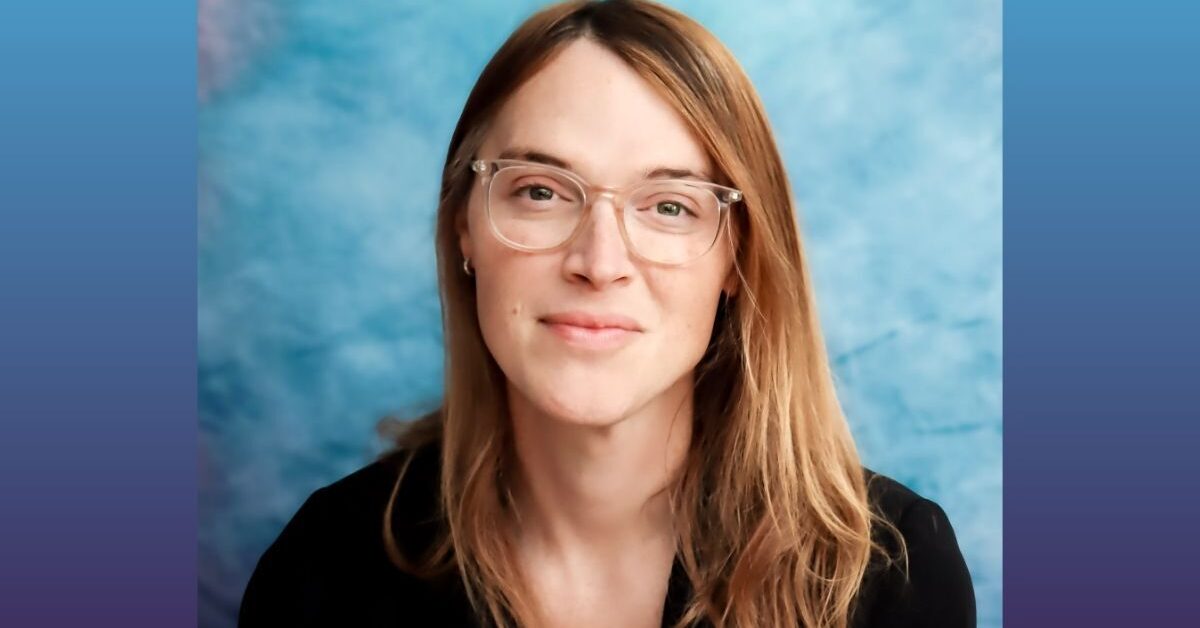

The Wayne County Clerk made it official May 12: Joanna Whaley is on the August primary ballot, and no amount of legal maneuvering from a fellow Democrat is going to change that.
Wayne County Clerk Cathy M. Garrett formally rejected a challenge filed by Frank Liberati, a former state representative also seeking Michigan's 2nd House District seat, who alleged that Whaley, a trans woman, had violated state campaign law by not listing her deadname on her affidavit of identity.
Whaley legally changed her name in 2025, a fact she demonstrated to the clerk's office, and she has been using the name Joanna in a common-law capacity since at least May 2022, far surpassing the six-month threshold required by statute. Jay Kaplan, the LGBTQ+ Rights Project staff attorney for the ACLU of Michigan, explained that Whaley's situation "should absolutely satisfy the requirements to not list her deadname on the ballot alongside her name."
Whaley isn't rattled.
"It has shown people a contrast of what I and our campaign have been doing all along, as opposed to trying to be sneaky in the background," she said. "We've been public and out front with what we're doing, and those are the type of leaders that Downriver wants."
She's running for a seat currently held by Tullio Liberati, Frank's brother, who was among the eight House Democrats who voted in favor of a Republican-led resolution that would have banned transgender girls from playing school sports. That vote was part of what pushed Whaley, a Lincoln Park-based hospital chaplain and former evangelical pastor, into the race in the first place.
The district and the fight
House District 2 covers Lincoln Park, Allen Park, Melvindale and parts of Southgate, working-class Downriver communities that Whaley talks about with real warmth and zero romanticism.
"Our district is a no BS type of community," she told Pride Source. "They want their leaders to be clear and transparent to the public. One thing I hear consistently from voters who are more in the middle and on the right is that they may not fully agree with my politics, but they like that I'm open and that I'm present and they always know what I'm up to as a candidate."
The thing those voters keep bringing up isn't Whaley's identity. It's the economy, especially their utility bills. DTE Energy recently requested a half-billion dollars in rate increases after already seeking a quarter-billion dollars just months before, even as the company posts record profits. Whaley wants to reform how monopoly utilities can ask for money and how they're compensated. She's also fighting for MiCare, a proposed statewide single-payer health care system, because she sees the human cost of the current system up close, every single day.
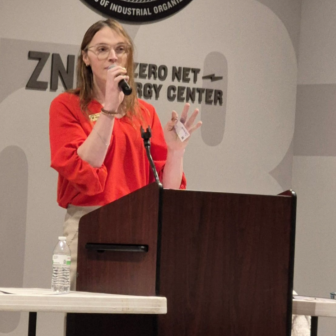
Whaley works as a clinical hospital chaplain, currently focused on hospice care. Her days move from virtual visits with families navigating end-of-life grief to in-person rounds at hospitals, long-term care facilities and private homes.
"One of the most heartbreaking conversations I have with people is when they say, 'I could fight this disease, but I can't afford it,'" she said. "And the most heartbreaking conversation I’ve ever had was with a patient who said, 'I could fight this, but I want to leave my children with all the money I've saved, and I don't want to spend it on trying to survive.'"
Whaley describes her work as an "honor."
"It sounds weird to love your job that requires you to be in a room with people finding out that their loved one has passed away," she said. "But I think that when it's all hitting the fan, you want someone who's going to be there and just be in the room and be willing to talk you through it. And I think that's what gives me a pretty unique skill set within our political space as well."
Whaley's path to chaplaincy winds through an unlikely career. She spent roughly 20 years in evangelical ministry, rising quickly in megachurch spaces and taking on pastoral responsibilities by age 20. She came out publicly at 34, after 15 years of conversion therapy directed by church leadership and carried out with four different therapists. She was eventually fired when church leadership heard she was considering a gender transition, then found her way to an LGBTQ-affirming congregation in Royal Oak.
It was there that she first encountered queer people who had lost their faith communities. That experience, combined with the clinical chaplaincy work she discovered through an internship at the University of Michigan, pointed toward what came next. She went back to Eastern Michigan University to finish her senior year, then earned a master's degree in theology from seminary, where she studied liberation theology, which she describes as "the study of marginalized people within divine systems and within political systems." It set her up for politics, she says, in ways she didn't anticipate.
'Just another Tuesday'
Whaley had expected attacks on her candidacy, just not from this direction. "This was just another Tuesday for me," she said. "This one was much more public — but very rarely has an attack on who I am become a positive like it has this time."
"I did not expect this from Frank Liberati. I expected this from one of the Republicans," she added. "I absolutely would have expected this coming from the other side of the aisle, but not within my own party."

Liberati did not respond to two requests for comment from Pride Source.
"If a Democratic member trying to seek the representative seat is trying to invalidate someone like myself from having access to a lawful name change, what else would he go after?" Whaley said about Liberati’s complaint. "And every time Frank tries to come after me, our campaign just gets stronger."
The Michigan Legislative LGBTQ+ Caucus called Liberati’s challenge "meritless" in a statement and said it "serves no purpose but to stoke the flames of transphobia for personal political gain." Michigan Democratic Party Chair Curtis Hertel said in a statement provided to Pride Source, "Democrats support the right of all people to live as their authentic selves — that includes candidates running for office. Attempts to disqualify candidates for using their legal name betrays the foundational principles of the Democratic Party."
Whaley credits her ability to weather the resulting stress of Liberati’s attack, in part, to her years in evangelical spaces. Coming out in the middle of that world, subjected to conversion therapy and navigating deeply hostile institutions, built something in her that Liberati's maneuvers haven't been able to touch.
"Believe it or not, my faith was really shaken before I even came out," she said. "I was working in very Christian nationalist spaces. One of the churches I worked for was really the hotbed of Christian nationalism within the Downriver area." The rise of that movement sent her into what many would call deconstruction. Her faith today is broader, more universalist. "Christianity is my first language," she said. "It is how I understand the divine." She came out of that world far more politically clear-eyed and with a talent that has proven useful on the campaign trail: spotting Christian nationalist dog whistles. "I know where that thought is going," she said. "I speak fluent Republican."
She's also developed a thick skin after two decades in ministry and a resiliency that seems impossible to stop. If anything, she's picked up steam since Liberati filed his complaints — as well as a good deal of campaign funds. Since the initial complaint gained public attention, her campaign cash on hand nearly tripled, going from around $9,000 to $25,000. She's received endorsements from the LGBTQ Victory Fund, Run For Something and U.S. Rep. Sarah McBride, and has spoken with McBride directly for guidance on navigating this kind of moment.
There are real costs, though. She's contracted with an executive protection firm that accompanies her to events, manages the logistics of where she stands in a room and how she exits. Her home has been outfitted with cameras. She has received credible threats that required police investigation.
"Sometimes I feel kind of ridiculous when I'm walking into events and there's all my other state rep friends who roll up in their cars, and I have to walk in with two bodyguard bouncer-looking dudes following me around," she said. "But that's the reality of what we're dealing with."
Security, she said, "teeters on our top three campaign expenses at this point," and a recent coffee shop meet-and-greet required multiple armed security guards on site because the threats ahead of it were credible enough to warrant them. "It feels like so much overkill for a House race," she said. "But the reality is that we've seen so much violence across the country towards elected officials."
When she's not campaigning or working, Whaley carves out space to just be herself. She has three young daughters, ages 10, 8 and 6, and every other weekend belongs entirely to them, no campaign calls, no events, no candidate mode. And every Tuesday night, she has dinner with her mom.
'We're coming'
Whaley is one of three transgender women seeking election to the Michigan House in 2026, a first in state history. The group, which includes Toni Mua in District 9 and Aaron Bailey in District 92, has taken to calling themselves the Dollhouse. Michigan has never elected an openly transgender state representative.
"I understand the potential historic significance of what this race could mean for our community," Whaley said. She says she and Mua have discussed “the weight of responsibility of this moment."
"Wherever you are in the state, if your state representative will not go to bat for you, I will represent you and I will show up even if it's three hours away from my district," she said. "For those who feel that Christian nationalism scares them, just know that there are progressive Christians coming to fight this battle with you."
The support from within the party has surprised her.
"I've just been overwhelmed by the response of people across our party," she said. "I'm really thankful for those that have spoken up to say this isn't OK, because I have not always experienced that when faced with hatred."
Through all of it, she says, the thing she's actually here to do hasn't changed.
"I'm just here trying to talk about getting our utility bills down," she said. "I'm here trying to get single-payer health care in the state of Michigan. These are the things that I'm talking about, and everyone else is bringing up my gender."
Joanna Whaley is running in the Aug. 4 Democratic primary for Michigan's 2nd House District. She faces Frank Liberati and Gary Schlack. Check vote411.org to confirm your voter status and to see sample ballots for upcoming elections.
Read More

A Michigan Farm Stand Became a Safe Haven for LGBTQ+ People in Rural America
On a farm stand in Charlotte, Michigan, in a county that voted for Donald Trump by a wide margin in 2024, Sarah and Kim Padilla hung a Pride flag and waited to [...]Read more about A Michigan Farm Stand Became a Safe Haven for LGBTQ+ People in Rural America

Trump Is Targeting the Smithsonian. My LGBTQ+ History Is Inside It.
There’s been something troubling me for the last couple of years about what the Trump administration has been doing. It affects me personally, but I’ve mostly [...]Read more about Trump Is Targeting the Smithsonian. My LGBTQ+ History Is Inside It.

Rethinking Masculinity: What Queer and Trans People Taught Me About Being a Man
I was the youngest “girl” — meaning assigned girl — in a large Midwestern farm family in the 1970s. We didn't talk much about gender, but masculinity [...]Read more about Rethinking Masculinity: What Queer and Trans People Taught Me About Being a Man
A Lifeline for LGBTQ+ Students in Michigan Schools Is Running Out of Money
For 25 years, the Michigan LGBTQ+ Students Project has worked to make schools safer for the state's LGBTQ+ youth, at a moment when many of those students [...]Read more about A Lifeline for LGBTQ+ Students in Michigan Schools Is Running Out of Money
Country Star Ty Herndon Marries Boyfriend Eric Schwartz At Outdoor Wedding in Tennessee
Country music star Ty Herndon, 61, just tied the knot with Alex Schwartz before a crowd of 300 on a farm in Chapmansboro, just outside Nashville. The ceremony, [...]Read more about Country Star Ty Herndon Marries Boyfriend Eric Schwartz At Outdoor Wedding in Tennessee

New State Budget Includes Unprecedented $10 Million Grant to Address LGBTQ+ Health Disparities
For the first time ever, the recently passed and signed 2023-2024 state budget will include an investment to address LGBTQ+ health disparities