Downriver Dem Files Complaint Against Primary Opponent, a Trans Woman, Over Her Name on the Ballot
Legal experts say Michigan law permits candidates to run under a commonly used name
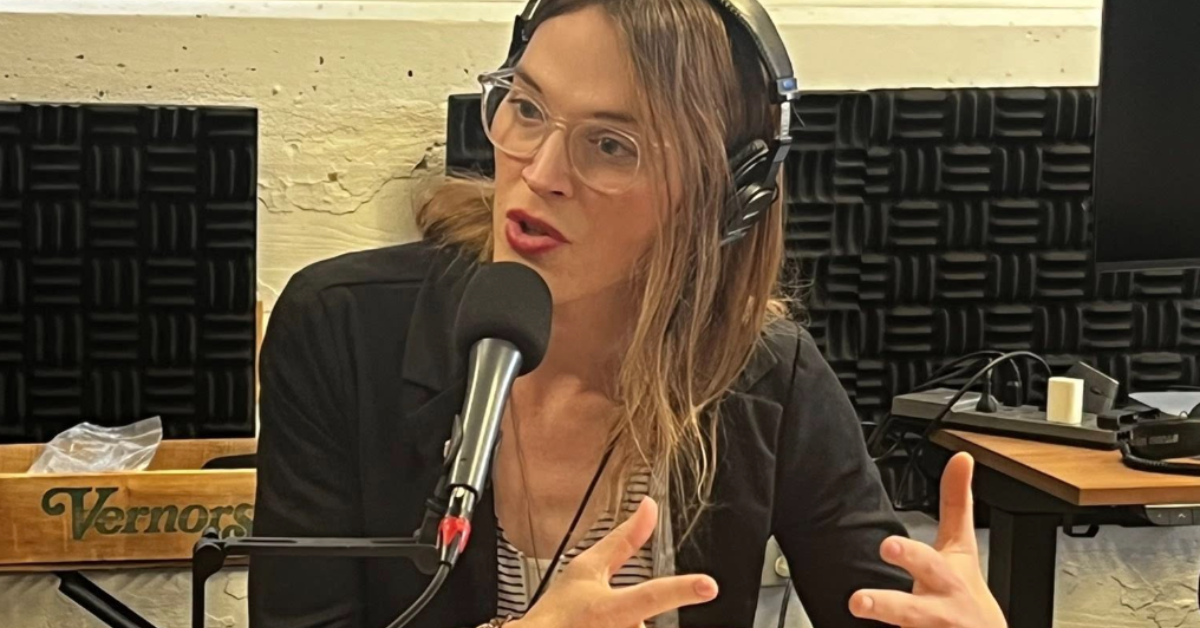

A Democrat running for Michigan’s 2nd House District in November has filed a campaign complaint against one of his primary opponents, a transgender woman, alleging that she violated state campaign law by not listing her deadname on her affidavit of identity submitted to run for office.
Frank Liberati, who represented Michigan’s 13th House District from 2015 to 2021, filed the complaint with the Wayne County Clerk’s office on Tuesday against Joanna Whaley, a clergy member from Lincoln Park. Liberati’s complaint alleges that Whaley did not list her legal name when she filed to run for office, citing a 2023 dismissed name change petition.
But Whaley did legally change her name — though the court proceeding that Liberati references in his complaint did lapse in 2023, she was able at a later date to go back to court and finish the legal proceedings. Those court records were sealed for her safety, she explained, as she was more of a public figure by that point.
Jay Kaplan, the LGBTQ+ Rights Project staff attorney for the ACLU of Michigan, also explained that Whaley, who has used the name Joanna for around five years, would qualify to have that name on the ballot as a “common-law name,” or the name that a person is generally known by.
Current Michigan law “requires a candidate to be listed on a ballot with their current name and former name, if the candidate is “required to indicate a name change on the affidavit of identity under section 558,’” Kaplan explained. But the exemptions to that rule include a name that “constitutes a common-law name as provided in section 560b.”
Section 560b establishes the same guidelines for ballots that the Michigan Secretary of State has in place for use of a common-law name on a driver’s license or personal ID card, which state that “a person would have to show documentation of regular, ongoing use of that name, not for fraudulent intent. We prefer that a person has been using said name for at least six months.”
Under those statutes, Kaplan explained, Whaley’s situation should absolutely satisfy the requirements to not list her deadname on the ballot alongside her name.
Liberati did not respond to a request for comment from the Michigan Advance.
“It’s not going to hold because we have all the proof and documents, and I’ve got 100 witnesses who know me by Joanna,” Whaley said, as the Wayne County Clerk’s office has asked her to submit proof that she uses the name Joanna in a common-law fashion.
If elected in November, Whaley would become one of the first — if not the very first — transgender state legislators in Michigan. She is one of two transgender women, along with Toni Mua in the 9th House District, seeking election to Lansing in 2026.
She hopes that by dealing with these types of attacks now, future transgender candidates might not have to face them — and she hopes that this is a lesson to all Democrats that these types of attacks are not the way forward within the party.
“My hope for future trans candidates is that we’ve gotten bloody enough to bust the hole in the wall that they can just walk through it,” she said. “I’m willing to take those punches to make it easier for folks in the future. And so that’s why, for me, it’s important to not just let this go.”
Whaley really wants to talk about the issues at hand, not her gender or identity. But she said that if she has to take a hundred interviews about something “unhinged” that someone else — of either party — has said about her, then she will use that opportunity to remind her community of her campaign’s values.
“I’m just here trying to talk about getting our utility bills down, I’m here trying to get single-payer healthcare in the state of Michigan,” she said. “These are the things that I’m talking about, and everyone else is bringing up my gender.”
Whaley also expressed her initial shock that she would be facing these types of attacks from within her own party.
“I did not expect this from Frank Liberati. I expected this from one of the Republicans,” she said, adding that she has received significant support from state party leadership and current elected officials. “I absolutely would have expected this coming from the other side of the aisle, but not within my own party.”
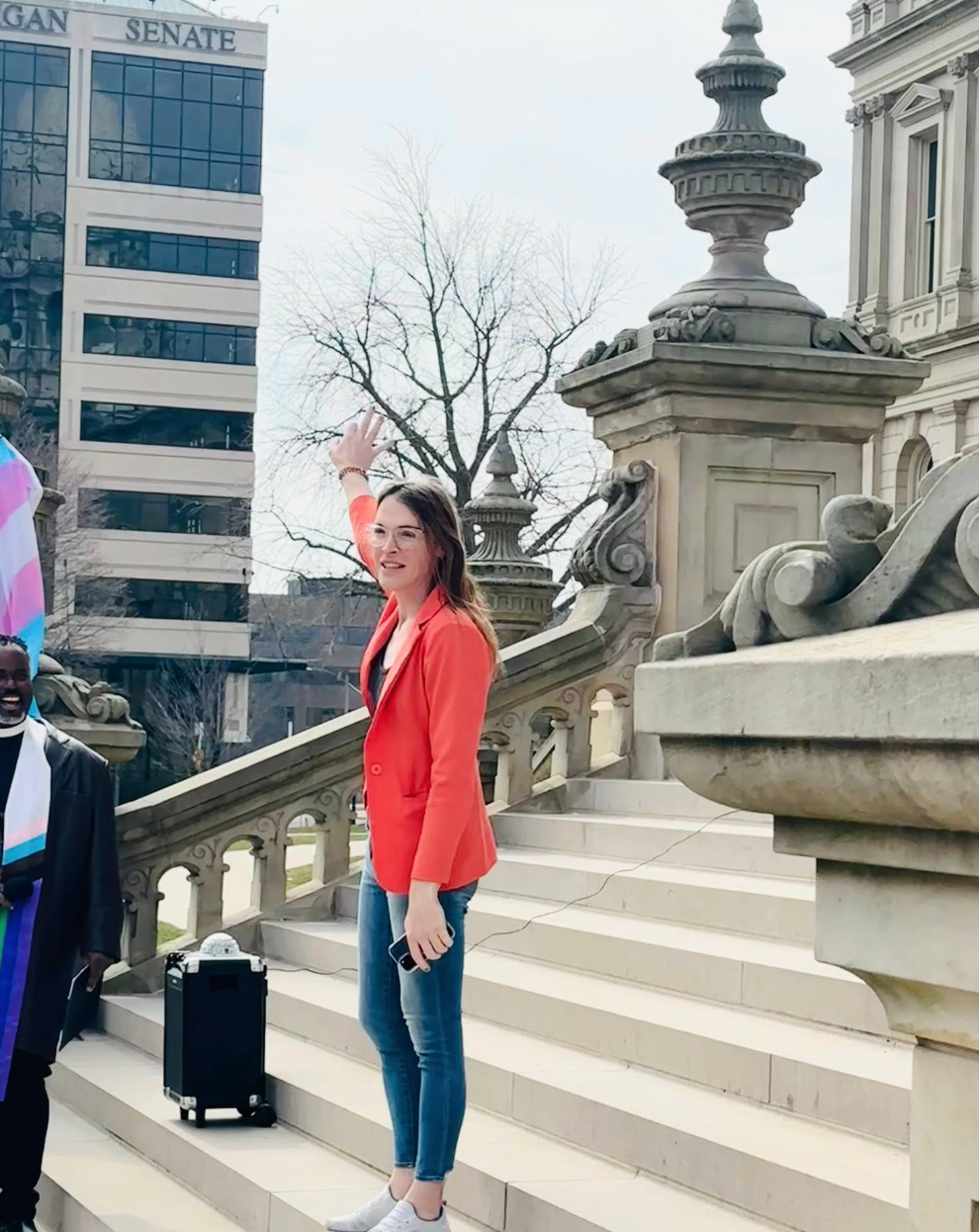
Michigan Democratic Party chair Curtis Hertel wrote in a statement to the Michigan Advance that, while the party remains neutral in primaries, they are “concerned by the developments in this race.”
“Democrats support the right of all people to live as their authentic selves — that includes candidates running for office,” he continued. “Attempts to disqualify candidates for using their legal name betrays the foundational principles of the Democratic Party.”
Additionally, the Michigan Legislative LGBTQ+ Caucus denounced Liberati’s lawsuit, calling it “meritless” and saying it “serves no purpose but to stoke the flames of transphobia for personal political gain.”
“Weaponizing transphobia as an electoral tactic has no place whatsoever in Michigan politics, and certainly not in a Democratic Party primary,” the caucus stated in a release.
Liberati’s brother, Tullio Liberati, currently represents the 2nd District, and his vote against allowing transgender girls to participate in girls’ sports was one of the driving factors for Whaley in deciding to seek the seat in the state House.
“I think it further reminds people that there really is only one person who acts and votes like a Democrat in this race, and we’ve been without a Democrat in that seat for a long time, even though they’ve had a D next to their name,” she said.
“We are a united party, and this type of behavior is just so uncharacteristic of what we see in the values of the Democratic Party moving forward,” Whaley said. “This is old-school politics, and it doesn’t really fly in the current Democratic Party.”
Whaley and Liberati, along with Gary Schlack, an Allen Park City Council member, are running in the August primary as Democrats for the seat, while Ron Kokinda and Zacharia Ortiz are running as Republicans.
This Michigan Advance story is reprinted with permission. Michigan Advance is part of States Newsroom, a nonprofit news network supported by grants and a coalition of donors as a 501(c)(3) public charity. Michigan Advance maintains editorial independence. Contact Editor Jon King for questions: [email protected].
Read More

A Michigan Farm Stand Became a Safe Haven for LGBTQ+ People in Rural America
On a farm stand in Charlotte, Michigan, in a county that voted for Donald Trump by a wide margin in 2024, Sarah and Kim Padilla hung a Pride flag and waited to [...]Read more about A Michigan Farm Stand Became a Safe Haven for LGBTQ+ People in Rural America

Trump Is Targeting the Smithsonian. My LGBTQ+ History Is Inside It.
There’s been something troubling me for the last couple of years about what the Trump administration has been doing. It affects me personally, but I’ve mostly [...]Read more about Trump Is Targeting the Smithsonian. My LGBTQ+ History Is Inside It.

Rethinking Masculinity: What Queer and Trans People Taught Me About Being a Man
I was the youngest “girl” — meaning assigned girl — in a large Midwestern farm family in the 1970s. We didn't talk much about gender, but masculinity [...]Read more about Rethinking Masculinity: What Queer and Trans People Taught Me About Being a Man

A Lifeline for LGBTQ+ Students in Michigan Schools Is Running Out of Money
For 25 years, the Michigan LGBTQ+ Students Project has worked to make schools safer for the state's LGBTQ+ youth, at a moment when many of those students [...]Read more about A Lifeline for LGBTQ+ Students in Michigan Schools Is Running Out of Money

Country Star Ty Herndon Marries Boyfriend Eric Schwartz At Outdoor Wedding in Tennessee
Country music star Ty Herndon, 61, just tied the knot with Alex Schwartz before a crowd of 300 on a farm in Chapmansboro, just outside Nashville. The ceremony, [...]Read more about Country Star Ty Herndon Marries Boyfriend Eric Schwartz At Outdoor Wedding in Tennessee

New State Budget Includes Unprecedented $10 Million Grant to Address LGBTQ+ Health Disparities
For the first time ever, the recently passed and signed 2023-2024 state budget will include an investment to address LGBTQ+ health disparities